Tag Archives: Bubble

G&M Likens Housing To Income Trusts – “The blowback if housing falls hard will be worse because homes are widely believed to be a special kind of asset that benefits the entire population.”

“If the slowdown in the housing market worsens, Mr. Flaherty will be blamed as he was after effectively killing income trusts in a surprise announcement made on Halloween night in 2006. The Minister, and his government, will be accused of being bad economic managers if the housing sector falters. But what people will really be saying is: “How dare you, Mr. Flaherty?”
People are funny about financial assets that soar in value, be they income trusts or houses. They see them as being special in some way, a phenomenon of nature that should be left untouched so as to allow folks to make some serious money.
But assets that soar in value are the ones we need to worry about most. Everything in finance is cyclical, which means there are ups and downs. The more an asset rises in price, the more vulnerable it is to a nasty pullback that causes damage both to individuals and the economy.
Mr. Flaherty moved to cool the overheated housing market last summer by capping the maximum amortization period at 25 years for people with down payments of less than 20 per cent. The impact of this move so far has been negative, but not alarmingly so. House sales were off 17.4 per cent in December on a year-over-year basis, but prices were up 1.6 per cent, on average.

Mr. Flaherty snuffed out trusts by announcing the government would start taxing them in 2011. In response, most trusts converted into dividend-paying corporations that pay far less cash than they used to. The complaining from investors about the demise of trusts was long and loud, although it never seemed to hurt the Conservatives in an election.
The blowback if housing falls hard will be worse because homes are widely believed to be a special kind of asset that benefits the entire population. It’s an easy impression to come away with after watching the rules shift over the years for home-buying down payments.
Decades ago, buyers had to put down a minimum 10 per cent and amortize over 25 years at most. The minimum down payment briefly fell to zero a few years ago and now it’s 5 per cent. Amortization periods expanded to as much as 40 years for a time, before being reeled back.

Housing’s stature has been further inflated by its cultural and economic importance. Multiple TV channels celebrate housing, and a fair chunk of the retail industry is directly home related (think of HomeSense, Home Depot, Home Outfitters, Home Hardware, Sears Home and the like). Also, housing-related spending accounts for close to 20 per cent of economic output. What’s good for housing is thought to be good for all of us.
Mostly, though, housing is thought to be special because of its value as an investment over the past couple of decades. As mentioned in a recent column (online at tgam.ca/Dlfb), housing prices nationally have risen about 5.6 per cent annually since 1980.
After five years of up and down stock markets, Canadians have become very possessive about their gains in housing. If housing prices plunge, they’ll be looking for someone to blame. That would be Mr. Flaherty, even if he was just doing his job.”

– from ‘First income trusts, now housing? Careful, Mr. Flaherty’, Rob Carrick, The Globe and Mail, 16 Jan 2013.

We like the way that this article emphasizes the ‘special’ place that housing has achieved through the 10 year national housing bubble. Nowhere more special than in our own Vancouver, of course.
A few thoughts:
1. Flaherty’s mortgage rule changes in 2012 were simply a slight tightening of restrictions that he himself had allowed to become far too loose in prior years.
2. When Flaherty announced the income trust rule changes in 2006, he exempted one class of income trust – those in real estate!
3. In trying to quantify the difference between the effects of changing the tax laws of income trusts, and tightening mortgage rules, it would be good to know how many Canadian’s had how much of their net-worth in income trusts in 2006. (Can any readers direct us to such data?) My hunch is that, even though that move was significant (and caused a massive brouhaha), it doesn’t come anywhere close to the magnitude of significance of mortgage tightening. Over 70% of Canadians own their homes; a large percentage have the majority of their net-worth in their homes; a significant percentage have their net-worth highly leveraged to the market value of their homes. In addition there are innumerable knock-on economic effects of a falling housing market.
The unwinding of the RE spec mania will completely eclipse memories of the 2006 income trust tax changes.
– vreaa

Now THAT Is A Laneway House

oWBlN

KTfWk

ePCDg

LtwLl

knp9A

UXwe4

71jEB

– found at http://imgur.com/a/ny4uA, by proteus (the poster with many names).

Somewhere in Europe, it seems.
Inexpensive, but sound workmanship. ($280K? We think not.)
Pleasant interior.
Non-leaking tiled roof.
Soul.
– vreaa

“I have homes in Canada and the US. I have a paper loss in Florida but still have a home.”

“I have homes in Canada and the US. Here in Florida there was a massive “correction” which led to total bankruptcy of a lot of people, huge losses by banks and a huge mess. I am not too sympathetic with people who borrow over their heads but Canada is far better off as it is than here. Fortunately both my houses were bought with cash I actually worked for and saved so I have a paper loss in Florida but still have a home. Others are not so lucky.”
– Skitty commenting at G&M, January 12, 2013 10:45 AM

This individual is not leveraged, and it seems they will be able to sit tight through any price fluctuation, if they wish.
But we know there are Canadians who have used HELOCs against their Canadian properties to buy US RE, and we wonder how many will be pushed to the brink by the very large price drops we anticipate in Canadian RE.
– vreaa

Curmudgeonly Contrarians Win Again (In The End)

“The thing that intrigues me most about his career is how, like Stephen Roche and so many of the great names who have conquered the Tour before him, the American has never encountered doping in the sport. In an extensive interview with L’Equipe on Monday he was asked if cycling still had a drugs problem? “I have no idea,” he replied. “There is none in my team. And none in any of the teams I have raced with. The Festina affair was a huge surprise to me.”
Really?
“Yes.”
And you never spoke about it in the peleton?
“Now that you mention it, no.”
Remarkable.
Incensed by the innuendo, Armstrong insists that his life is an open book. He says he is clean and has no secrets and asks us to treat his achievements with the respect they deserve. Should we? Sorry, but for some time now I’ve had a problem with fairytales in sport. For the moment I’m reserving my right to applaud.”
– Paul Kimmage, in an article ‘Reserving the right to applaud’, Irish Independent, 26 July 1999  (yes, nineteen ninety nine).

This contrarian was ‘wrong’ for at least 13 years.
Now he’s right, and the underlying facts of the matter seem so self apparent to all observers.
Of course Armstrong doped, how else could he have won 7 Tours in a row?
RE bubbles are like ‘fairytales’, too.
Of course this was a speculative mania, how else could Vancouver RE prices have risen to the point that the average home was ‘worth’ 11.5 times average annual income?
Vancouver RE contrarians have thus far been ‘wrong’ for up to 10 years, but the jury is making noises that it is returning with a verdict.
– vreaa

“One agent is telling him to drop his price drastically to beat reduced prices in the Spring. The other agent is telling him that he has to keep his price above $1 mil to attract foreign buyers.”

“Just talked to a friend trying to decide which agent to use to sell his house in central Vancouver. One agent is telling him to drop his price drastically to beat reduced prices in the Spring. The other agent is telling him that he has to keep his price above $1 mil to attract foreign buyers. Still too many agents with the former pitch and too many people who want to believe it.”
pathcontrolmonk at greaterfool.ca 17 Jan 2013 at 10:11 pm

“By the time they listed, buyers were no longer competing for the privilege of overpaying. She accepted the fact that her condo just wasn’t worth what she had hoped.”

“Last summer, having surveyed their local real estate market, and finding themselves spooked by deteriorating prices, Rheanna Mushet and her husband, Justin, decided to sell their Burnaby condo. “We wanted to cash out,” Mushet says, adding that they may end up living in her parents’ basement for a while as they wait out the downturn in the Vancouver market. “We’re going to make sure we get the most for our money. There’s no hurry.” She only regrets not acting sooner. By the time they listed, buyers were no longer competing for the privilege of overpaying. For six months, the Mushets waited for an offer and showed their condo to prospective buyers who seemed to be almost looking for a reason to pass. “They were very choosy,” she says. “‘It’s not on the right floor. The ceiling’s not high enough. There’s a stain on your carpet.’ Just the silliest things that before wouldn’t even be a consideration.” They finally agreed to sell for $22,000 below their original asking price to the first person to make an offer. She accepted the fact that her condo just wasn’t worth what she had hoped. Many other sellers are soon going to have to come to the same realization.”
– from ‘How low will house prices go? Prices are headed down for the long term.’, Tim Shufelt, Canadian Business, 17 Jan 2013 [hat-tip Cyril Tourneur, Anon and CanAmerican]

BC Architectural Firm Job Interviewer Likens Helicopter Parenting To Housing Bubble

“Walking into a job interview with a Canadian architectural firm, a young candidate brings something unexpected: mom.
An employee with the British Columbia company says it was the first time she had seen a parent shadow the hiring process, describing what ensued as “a bit of an awkward situation.” But she adds that there have been at least five or six recent occasions in which a mother or father sat with their grown child in the waiting room before an interview.
According to experts, this could soon become commonplace.

At the B.C. architectural firm where a parent sat in on a candidate’s interview, a staff member – and a mother herself – says she would have been “mortified” had she been in the young person’s shoes.
“I wonder what would happen if we all stopped pushing our kids to succeed and just let natural selection run its course? Sort of like the housing bubble: let the whole thing burst instead of running around to tutors, afterschool programs, language lessons, and lining up to register for sports programs,” said Helen, who asked that her last name not be used.
“Of course, that’s never going to happen.”

– from ‘Helicopter parents increasingly follow kids to college, the workplace and beyond’, Misty Harris, Postmedia News, 16 Jan 2013 [hat-tip harden]

Filed under RE References In Popular Culture‘.
We seem to be seeing an increase in such mentions.
– vreaa

Bearish Quotes In ‘Canadian Business’; Economists Chase Falling Markets With Lower And Lower Price Predictions

“Buyers are sensing that prices are going to come down, so why buy now?” – Thomas Neal, a Royal LePage agent in Toronto

“A potentially severe housing correction is underway” – David Madani, an economist at Capital Economics

“We’ve got a number of sellers who say, ‘If we’re not going to sell for a particular value, we’re not going to sell at all. A lot of people are still pricing their properties based on yesterday’s market.” – Victoria real estate agent Tony Joe

“[Mortgage changes are] taking a lot of demand out of the market. You’re putting the housing market at risk, and the broader economy. The market is weak enough it could result in prices falling in many places across the country.” – Will Dunning, chief economist for the Canadian Association of Accredited Mortgage Professionals

“Developers are saying it’s a very small percentage of end users that are purchasing in the market.” – Ben Myers, executive vice-president at condo research firm Urbanation.

Even most bank economists believe Canadian housing is overpriced somewhere in the range of 10% to 20%, perhaps more so for the hottest condo markets.
“That’s manageable as long as interest rates and unemployment remain low. Absent an external economic shock that would ultimately put Canadians out of work, there is no reason to expect markets to correct hard and fast. What would force people to feel that they have to sell at much deeper prices, given that the interest rate environment is likely to remain quite benign at least through next year? Without a trigger, there should be no national housing crash.” – Doug Porter, BMO economist

– from ‘How low will house prices go? Prices are headed down for the long term.’, Tim Shufelt, Canadian Business, 17 Jan 2013 [hat-tip Cyril Tourneur, Anon and CanAmerican]

Note that now ‘economists’ are quoted as being in agreement that “Canadian housing is overpriced somewhere in the range of 10% to 20%”. Not that long ago they agreed that range was 5% to 10%. They are simply chasing the prices down. These estimates have no predictive capacity whatsoever, they are commentary of past events. [Madani is an exception. He has consistently called for 25%-off at the national level.]
– vreaa

House Price And Family Income Growth

House Price and Family Income Growth, 2000 -2010
– chart care of Kevin at saskatoonhousingbubble, 15 Jan 2013. [Thank you Kevin.]

A nation-wide bubble in home prices, driven by cheap financing and local speculators.
– vreaa

“I personally know of a friend who was offered the moon from the bank to buy a home in October. This month the same bank is reconsidering the mortgage. Nothing has changed for my friend’s finances.”

“Sadly, I’ve been hearing lots of stories of financing falling through. Banks have done a 360 degree turnaround. They are still lending, but on their terms. Not so attractive terms. I personally know of a friend who was offered the moon from the bank to buy a home in October. This month the same bank is reconsidering the mortgage. Nothing has changed for my friend’s finances.”
enlightened at VREAA 16 Dec 2013 3:36am

‘Old Curmudgeon’ Has Audacity To “Force People To Confront The Consequences Of Their Own Debt”

“I own my house. I have no debt. Why? Not because I was lucky or rich. But because I never borrowed for consumables. My house is not an investment. Whether it is worth $100,000 or $1,000,000 is irrelevant. It’s where I live. It’s a roof over my head. I had to get a mortgage for the house, but worked on paying it off with spare cash. I didn’t have to have a car. Nor yearly vacations in exotic locales. I didn’t eat out a lot. I didn’t need a lot of clothes. And I don’t give a sh*t about impressing the neighbours.
For the most part, all the debt problems people have stem from their own greed, consumerism and lack of self-control. Don’t blame the market. Don’t blame the banks. Blame yourselves. But in our society, it is impolite to force people to confront the consequences of their own actions.”

– Old Curmudgeon, commenting at ‘Why lower home prices are a national priority’, Globe and Mail, 11 Jan 2013 9:26PM

‘Old Curmudgeon’ is in this situation in part because of his sensible ways with money, but also because he was very likely fortunate enough to buy at a time when house prices were more reflective of underlying fundamental value. And that is how it should be, after all. Homes as places to live, rather than as financial instruments.
His indignation with debt-spending is well placed.
– vreaa

From the article on which ‘Old Curmudgeon’ is commenting:

If Canada wants to slay its household-debt dragon, it will have to cut down house prices at the knees. But there’s an economic price to pay for that – and it goes well beyond a cooling of the residential real estate sector. …
“…house prices appear to drive non-mortgage debt, too – the more valuable your house, the more debt you’re likely to take on outside of your mortgage. And, since close to half of all non-mortgage debt is used to finance consumer purchases, higher house prices ultimately boost our national consumption, too.” …
“… the 52-per-cent rise in national house prices from 1999 to 2007 was responsible for a 19-per-cent increase in homeowners’ non-mortgage debt.”… “Multiply that by approximately 13 million households, and that’s nearly $10-billion more in annual consumption – or roughly a 2-per-cent juicing of non-housing consumer spending.” …
“A substantial downturn in prices – say, 10 to 20 per cent – would, in theory, not only reduce mortgage debts for new home buyers, but, significantly, push down non-mortgage debt to the tune of 4 to 8 per cent.” …
“A downturn in consumer borrowing is going to put a serious lid on consumer spending growth – which up until now has been a critical driver in Canada’s economic outperformance since the 2008-2009 global recession.
In the long term, this is the price to pay to get Canadians back living within their means, and the economy on more solid footing. But in the nearer term, the medicine could well feel worse than the disease.

– from ‘Why lower home prices are a national priority’, David Parkinson, The Globe and Mail, 11 Jan 2013

Trading A Hockey Goalie Likened To Trading Vancouver RE [also, RE Market Commentary] – “You may think the Luongo market was something like the booming RE scene a few years ago. But everyone knows what happened in Vancouver RE. One day, the money turned off like a tap.”

luongo-roberto
Curb Appeal

“Vancouver GM Mike Gillis made trading Roberto Luongo sound like a breeze.
If you listen to Gillis, you may think the Luongo market was something like the booming real estate scene in Vancouver a few years ago. Don’t like an offer? Wait an hour, a day or a week. A better one always seems around the corner.
But, let’s be real, that’s exactly what the Canucks need everyone to think, whether it’s reality or not.
“There’s been a lot more interest than people wanted to recognize,” Gillis said.
But what if you wait too long? Everyone knows what happened in Vancouver real estate. One day, the money turned off like a tap. What if teams interested in Luongo make alternate plans, unwilling to meet those Canucks’ demands?
“I’m not concerned about that at all,” Gillis said in his opening press conference, kicking off training camp. “Not one bit. I think there’re going to be multiple opportunities to do something with Roberto, if we choose to do it.”

– from ‘Gillis insists there’s no hurry to trade Luongo; GM says club will wait for ‘specific kinds of players’, Jason Botchford, The Province, 13 Jan 2013 [hat-tip to JL, for the link via e-mail, and who writes: “I wasn’t sure whether I was reading the sports section or the business section. Oddly enough the sports section of the Province seems to know more about the state of the Real Estate market than the business section.”]

Not only an extended RE metaphor (anybody still want to argue that RE hasn’t completely saturated the city’s psyche?) but also a comment on the RE market: “Everyone knows what happened in Vancouver real estate. One day, the money turned off like a tap.”
If this really is what “everybody knows”, the sentiment shift may occur quicker than we’ve anticipated, in which case expect an even chiller spring than bears have been forecasting.
– vreaa

Related posts:

Canucks Hockey Player Expresses RE Market Hope – “We finally bought in the Vancouver market and hope it keeps going up”
VREAA 9 Sep 2011

“NUX TIX OR MORTGAGE PAYMENT?” [Playoff-Placard]
VREAA 5 Jun 2011

And regarding using Luongo-trading techniques to sell Vancouver RE:

The Myth Of The Cool-Headed Discretionary Seller
VREAA 19 Dec 2012

Author Of ‘Real Estate Investing for Canadians for Dummies’ “jumped into the market 3 years ago with a 2 BR apartment in Mount Pleasant”; Reports Ownership Cheaper Than Renting; Leaves Out Math

“This columnist jumped into the property market three years ago with a two-bedroom apartment in Mount Pleasant. The mortgage payments at the time were on a par with where rent was heading, so the move made sense. Despite increases in strata fees and property taxes since, the move continues to make sense – perhaps more sense than ever.
Tallying mortgage interest, property taxes, strata fees and assessments, as well as home insurance paid in each of the past four years versus rent and home insurance paid in 2008 (the last full year in which rent was paid) shows that home ownership has steadily cut household expenses. Preliminary figures for 2012 indicate savings on housing costs of more than 20% versus 2008.
Poor affordability tends to give first-time buyers in Vancouver fewer options than those in other cities, but the pay-off – for those who can manage it – is significant.
So long as mortgage costs remain in check, the payoff seems set to continue, but low interest rates and increases in rental costs have so far put accounts in this buyer’s favour.
(The exit strategy and ultimate return on investment is a significant risk factor, of course, but we’ll leave that matter for another column.)”

– from ‘Rental market tight despite rise in Vancouver vacancies; apartment sales projected to hit record-breaking pace’, Peter Mitham, Business In Vancouver, 8 Jan 2013 (“Peter Mitham has written about British Columbia real estate since 1998 for Business in Vancouver and many regional, national and international publications. He is co-author of “Real Estate Investing for Canadians for Dummies”)
[hat-tip Sarbaz]

Priceless stuff. And that’s a major problem — no ‘price’ – no numbers, no math.
We’d love to see the details. The claim seems to be a stretch.
Just for a start, is this a comparable 2BR to the prior rental?

Also, interesting to note that an author of a RE investment text:
1. “jumped into” the property market, and
2. talks of the ‘return on investment’ – for his home!
– vreaa

Ikea’s Imaginary Home Office Belonging To An Imaginary Realtor

IMG_3619

IMG_3621

IMG_3620

– The above images from Lex Limo, via e-mail, to VREAA, 13 Jan 2012.
Lex also writes: “I’m not sure if this counts as popular culture, but I got a kick out of the way this one particular workspace was decorated at IKEA. It seems this imaginary home office belongs to an imaginary realtor, a pretty successful one in 2011 it would seem. I’d be curious to know if this is a standard staging across all IKEAs or if this was a choice made at the local level. Also, do realtors really put up pictures of their sold signs in their RIBBA picture frames on their HEMNES desk shelves?”

Ask yourself: Would an Ikea in Spain be doing this now?
(We think not.)
Another sign of our speculative mania, in this case a ‘latter-day’ sign. Also evidence that general sentiment has yet to turn in a significant way; the guys at Ikea still see the idea of selling real estate as attractive enough to use as subliminal bait. This will change as prices descend.
Thanks to Lex for capturing and sharing the images.  Archived under the ‘References To RE In Popular Culture’ category.
– vreaa

‘The Economist’ “Home Truth” – “Overvaluation is especially marked in Canada.”

“Overvaluation is especially marked in Canada, particularly with respect to rents (78%) but also in relation to income (34%). Mark Carney, the country’s central-bank governor, who is soon to jump ship to join the Bank of England, where he takes over from Sir Mervyn King in July, may have shown good market timing with his move to London as well as a deft hand in negotiating his lavish remuneration. …
At some point, central banks will have to take away the balm of easy money. If housing markets remain so fragile when they are getting so much help, they may break when it is removed.”

– from ‘Home truths’, The Economist, 12 Jan 2013

And Vancouver rent and income ratios are far more extreme than the national averages.
– vreaa

‘The Economist’ has steadily been warning of a Canadian RE bubble for some time:
‘The Economist’ – Rental Income Shows Canadian Home Prices Are 71% Overvalued, 25 Nov 2011

Spot The Speculators #95 – “Each had a house with a mortgage. Then they bought a new residence and used a line of credit to add a rental apartment to the new house. Their $1.5-million of debt is 12 times their gross employment income.”

“A couple we’ll call Tiff (49) and Sandy (45) turned their long-time friendship into a union when they bought a house in British Columbia and combined their fortunes in 2008. The relationship came with a lot of baggage, however. Each had a house with a mortgage. Then they bought a new residence and used a line of credit to add a rental apartment to the new house. Their $1.5-million of debt is 12 times their gross employment income.
Revenue from the income properties barely covers their total costs — mortgage and line-of-credit interest, taxes, utilities, insurance and maintenance. Add in falling prices in the sliding B.C. housing market and the couple is subsidizing losing investments.
They save only $100 a month for RRSPs and $25 a month in an RESP for a Sandy’s nine-year old child from a former marriage. At mid-life, the couple, each of whom works for a large publishing company, has just $31,000 of RRSPs and almost no cash.”

They started with 25% conventional down payments, but now find themselves with about 10% equity in the rental units as a result of falling property prices and debt-financed buyouts of former partners. Their return after paying all interest costs, utilities, insurance and taxes is negligible. Unless they can raise rents drastically or realize future capital gains, the investments are flops.

A financial crisis triggered, perhaps, by unemployment, illness or accident would require them to add debt, for they have just $2,000 in cash. If interest rates rise by 1% or 2%, they would be forced to refinance, but they already have 30-year amortizations. To pay more interest, they would have to face deregistration of some or all of their $31,000 of RRSPs, heavy taxes on payouts or, in the worst case, bankruptcy.

Family Finance asked Adrian Mastracci, a portfolio manager and financial planner at KCM Wealth Management Inc. in Vancouver, to work with the couple. He is candid in describing the issues.
“The couple’s problems are far too much debt, especially for properties that are poor investments, and an excessive concentration in real estate, for each unit is within just blocks of the others,” he says.

Real estate has produced substantial gains for homeowners in parts of B.C., but the boom is waning. When interest rates rise, prices could fall further, for most people buy what they can afford and, with higher borrowing costs, they will afford less.

– from ‘Bad real estate investments leave couple with $1.5-million in debt’, Andrew Allentuck, Financial Post, 11 Jan 2013 [hat-tip JoeQ]

Summary of finances for this couple:
Assets $2M [$1.862M in RE at current market prices; $137K other]
Debt $1.542M [3 mortgages, 1 LOC, CCs, Car loan]
Net worth $456K [Assets minus Debt]
Ratio of RE holdings to Net worth: 4.1 to 1
Put another way, more than 400% of their net worth is in RE.
(I find this figure as shocking as the debt to income ratio of 12)
If/when the market price of their RE holdings drop 25% they would be wiped out.

What, me, a speculator?
Just innocent locals doing what innocent locals do, right? Building wealth with RE.
How many more out there are in similar situations?
– vreaa

Buy The Dip! – “Our families have been pressuring us to buy a place as the prices are coming down.”

“We got married 1.5 years ago. My husband doesn’t believe in buying a place, so currently, we are renting in downtown Vancouver. We have combined saving of $150,000 plus some assets in gold. We have a combined household income of $115,000. Initially, our goal was to save one of our salaries but realistically it hasn’t happened yet. We plan to start a family soon and will need a bigger place. Our families have been pressuring us to buy a place as the prices are coming down. Since both of us work in downtown Vancouver, we don’t want to move to suburbs like Surrey where houses are cheaper but has longer commute. Do you think prices in North Vancouver will come down in the near future?”
Jasmine, as relayed by Garth Turner, greaterfool.ca, 8 Jan 2013

There will be a subgroup of buyers who jump in at 10%-15% off, thinking we’ll have a re-run of the 2009 ‘dip and bounce’. They will be as severely punished for their purchase as any other buyers in the last 5 years.
Notice, too, that these advisors/buyers are very early ‘premature-bottom callers’.
– vreaa

“The Richmond home had been for sale for about six months, and rather than lower the price any further, the couple decided to take the home off the market. They are in their late 60s and want to downsize to a condo.”

“Realtor Larry Biggar said one of his clients did just that in November. The Richmond home had been for sale for about six months, and rather than lower the price any further, the couple decided to take the home off the market. They are in their late 60s and want to downsize to a condo, Biggar said. He said everyone who went through the home liked it, but that they all seemed to be waiting to see what would happen with prices.
“We watched the market slow down, and slow down, and slow down. … It just got quieter and quieter,” said Biggar, who works with ReMax Westcoast.
“Finally they said enough is enough. We really don’t have to sell. We can stall our plans if need be, although that’s not our first choice.”
Biggar said the couple will be putting their home back on the market soon, and although they have not discussed the asking price, it will probably be the same price it was when they took if off the market.”

– Richmond News 9 Jan 2013, as quoted by Real Estate Tsunami on VREAA

See The Myth Of The Discretionary Seller for discussion of the syndrome of ‘Sellerpause’©. – vreaa

Everything Is (Still) Going To Be Alright ?

2013 everything is going to be alright
– image posted on reddit, 2013 [hat-tip proteus]

This art work, by Martin Creed, on the outside of Bob Rennie’s gastown gallery was first featured at VREAA way back in November 2009. Take a look at that post for background discussion.
We like this piece, particularly the way its meaning will change through all phases of the massive economic cycle that RE has brought this city.
An interesting issue to consider will be whether, at some point in the descent, Bob Rennie decides to take it down. While the market is ripping and everybody’s ‘rich’, it’s a battle-cry, a cheerleader slogan; it’s very easy to ‘own’ it then. But through the coming years when prices are dropping, and people are hurting (and complaining), at the very point where many will need reassurance, will Mr Rennie be able to bear the complexities of keeping this work on display?

– vreaa

College Student Living With Parents In $7M “Piece Of Junk House” – “I have had to sit through countless dinners where my parents friends bragged about foreign investors leaving notes in their mailboxes making cash offers on their houses and how they could “cash out” at any time. But they didn’t.”

“I am a college student living at home in a house assessed at 7 million dollars. With that price tag you would expect a mansion right? Nope. The house is 90 years old, doesn’t have insulation or a proper heating system. My parents bought the house in 1985 for 450,000. Adjusting for inflation that is 860,000 in 2012 dollars. That is the most I would pay TODAY for this piece of junk house. However we do live in a quiet area in the UBC area and the property itself is quite large with a premium view, but even those factors do not begin to justify the difference between the assessed value and the inflation adjusted price my parents paid 28 years ago.
Luckily my parents were smart with their finances and a large correction in the market will not affect them. My parents have avoided using any paper gains in the property even when their coworkers and friends kept pestering them to take out loans against the house to buy condos and rental properties. These same coworkers and friends have been driving around in fancy leased cars and enjoying nice vacations every year while my parents worked hard to pay off the mortgage. I have had to sit through countless dinners where my parents friends bragged about foreign investors leaving notes in their mailboxes making cash offers on their houses and how they could “cash out” at any time. But they didn’t. Now that they do want to sell they are finding the market has cooled and no on wants to pay peak prices for their homes. Very few people are prepared to spend 15 million dollars on a home in a cooling market.”

Robert Borden at VREAA 8 Jan 2012 3:43pm

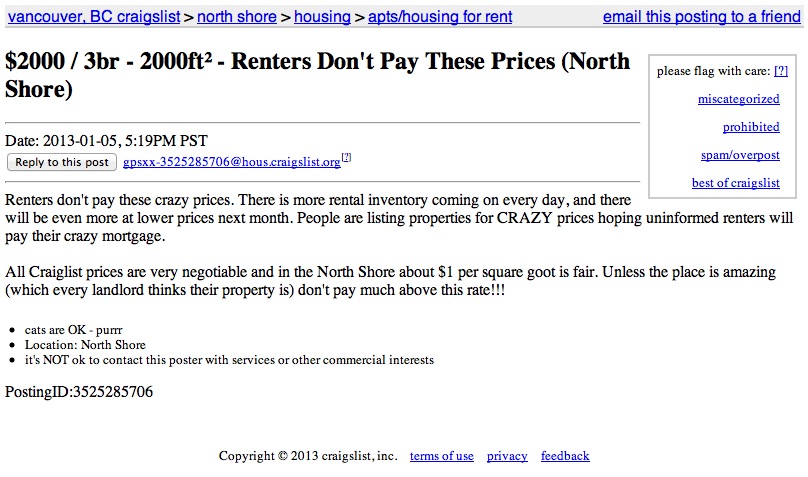
“People are listing properties for CRAZY prices hoping uninformed renters will pay their crazy mortgage.”

craigslist

“$2000 / 3br – 2000ft² – Renters Don’t Pay These Prices (North Shore)
Renters don’t pay these crazy prices. There is more rental inventory coming on every day, and there will be even more at lower prices next month. People are listing properties for CRAZY prices hoping uninformed renters will pay their crazy mortgage.
All Craiglist prices are very negotiable and in the North Shore about $1 per square foot is fair. Unless the place is amazing (which every landlord thinks their property is) don’t pay much above this rate!!!”

– from craiglist, 5 Jan 2012 [hat-tip edinacloud]

Royal Bank, CIBC, BMO, CTV, REBGV, Michael Levy, Royal LePage, Global TV – “Housing Crash Fears Unwarranted”; “There is no property bubble. Period.”

vanc re keep calm

In contrast to the recent MacLean’s ‘2013 Crash’ article, we now have a surging surfeit of reassuring commentary from other sources:

“Canada’s real estate market remains “relatively solid” and should experience a “soft landing” despite the current slowdown and fears of overbuilding in the condominium segment, the country’s leading bankers said Tuesday. …
“Our expectation is that the overall real estate market in Canada is still relatively solid,” Royal Bank CEO Gord Nixon said. …
“Pure math says that a soft landing, if it means you go back historic levels of activity, that we’re going to have some softness in our economy,” Gerry McCaughey of CIBC said.
“… That softness doesn’t necessarily come out in mortgage defaults, it comes out in employment softness and consequential unsecured consumer lending softness.” …
“In fact, house prices may just stagnate. Condominium prices may just stagnate for a couple of years. And that’s the definition of a soft landing,” Bank of Montreal CEO Bill Downe said.”

– from ‘Bankers expect soft landing for Canadian housing market despite slowdown’, Canadian Press care of CTV News, 8 Jan 2013 [hat-tip Dr. Bubble]

“I just watched ctv vancouver news. they did a 5 minute piece on real estate here. they interviewed two realtors and one guy from real estate board. they all said prices of sfh in vancouver were down 1 % for 2012 and say prices won’t fall more than 3% in 2013 as sellers don’t need to sell so they will just pull properties and wait…so buyers who are expecting big drops will not ever see that. the real estate board guy said there is nothing in the cards that is showing sellers will have to sell so prices will stay high. then the host of the news said, well, there you have it… no bubble popping here and went onto next story.”
– vancouverbubbleman at VREAA 8 Jan 2013 5:49pm

Michael Levy, financial analyst: “There is no property bubble. Period. We’ve had prices come up because of demand, both domestic and from off-shore, and demand swelled, and particularly here in Vancouver, a most desirable place to own property, you want to live here or invest here.” …
Announcer: “Prices seem to be holding, as the tug-of-war between buyers and sellers continues.”

– from ‘Experts Say No Real Estate Bubble In Vancouver’, Global TV News, 8 Jan 2013 [video archived by Greenhorn; hat-tip YVRhousinganalyst]
[“There is no property bubble. Period.” – this latter-day pronouncement added to “What Bubble?” sidebar]

“Royal LePage forecasts that the price of an average Canadian home will rise by a modest 1% in 2013.
Canadian home prices will see a “very modest” appreciation over the next two years, as economies in both the U.S. and Canada gradually improve and family incomes climb slowly, the brokerage said.
“More home buyers moved to the sidelines as 2012 progressed, as economic uncertainty abroad and reduced affordability became a drag on the market, however house prices proved resilient,” said Phil Soper, president and chief executive of Royal LePage.

– from ‘Housing-Crash Fears for 2013 Unwarranted, Forecasters Say’, WSJ, 8 Jan 2013

Update – West-side Houses Selling At 2008 Prices

4549 W 12th Ave, Vancouver West-side
2,569 sqft SFH on a 33×122 lot; built 1933

This particular house previously featured on these pages:
‘Half The Width, Twice The Price’ 25 Apr 2012
‘Next Stop, 2008 Prices’ 19 Nov 2012

Price history:

1:
March 1997: Sold $457,500

[renos in 1998]

2:
April 2008: For Sale at $1,679,000
May 2008: Price reduction $1,595,000
May 2008: Taken off market
June 2008: For Sale at $1,495,000
July 2008: Sold $1,430,000

3:
April 2012: For Sale at $1,975,000
Jun 2012: Price reduction $1,875,000
Taken off market
Aug 2012: For Sale at $1,775,000
Nov 2012: Price change $1,698,000

4:
21 Dec 2012: Sold $1,550,000

Increase of $120K (8.4%) over 4.5 years (since July 2008), for a compound annual rate of 1.8%, pretty much the rate of inflation, so this property did indeed end up selling for the same real price as in the summer of 2008. Of course, with transaction costs factored in, this represents a loss for the recent seller.
According to examples such as this one, west-side SFHs are back to 2008 prices, as much as 25% off 2011-2012 peak, and there does not appear to be any good reasons to suggest that they’re not going to continue to fall. At $1.55M, this property has still sold far above it’s fundamental value.
This is what speculative manias look like when they begin to unwind.
– vreaa

Linguistic Contortions From The Vancouver RE Bubble – “Unsexy” Markets and Other Dissemblage

communication

“Perhaps there’s an additional category you could consider for anecdotes — something like “Spokesperson Spin”, or “Bubble Euphemisms”. The linguistic contortions we’ve been subject to over the months and years have been quite something. And after all, language is the primary tool that the RE industry, the banks, etc, have been using to promote their version of things. “Unsexy” and Doug Porter’s “bumpier” are obvious euphemisms. Referring to Yaletown as a “borough” is obvious spin. Regarding your question of how a ‘Discretionary Seller’ might or should feel about these types of pronouncements in the MSM, I’d say the greater the linguistic dissembling, the greater the urgency to believe the exact opposite and act accordingly.”
Froogle Scott at VREAA 21 Dec 2012 9:02am

“bubblespeak”
bubbly at VREAA 21 Dec 2012 9:25am

“bubblexicon”
– [I seriously thought I’d thought of this, but it gets 6 hits on Google. 7 now. -ed., 3 Mar 2013]

Great idea, Froogle Scott.
Let’s collect examples here, we’ll reference this post by sidebar graphic, and by the new category ’29. Bubblespeak’.
Please submit examples by commenting below or via e-mail.
Anybody finding examples in prior anecdote posts, please bring to our attention.
Some words and phrases we may have to debate. Does ‘Vanhattan’ count?
Let’s begin:

“Anecdotal” – [dismissive label for any specific story that suggests market weakness]

“Balanced Market” – [euphemism for weak market; falling sales, falling prices]
related: “Balanced territory”, “balancing effect”

“Balloon” – [euphemism for speculative mania; idea that market can deflate in a controlled fashion; see also ‘soft landing’]
“In our view, the national housing market is more like a balloon than a bubble. While bubbles always burst, a balloon often deflates slowly in the absence of a pin.” – Sherry Cooper, BMO economist, 31 Jan 2012

“Basement Dweller” – [derogatory term for one too sensible to buy into a speculative bubble]

“Best Place On Earth” – [extreme version of “it’s different here”]
related: “World Class”; “Everybody wants to live here”

“Bidding Wars” – [buyers fighting to the death; winner loses]

“Breaking Through In Thought Leadership” – [over-reaching optimism, with a twist of Orwell]
“This is a game-changer for Vancouver. We’re known as a world-class tourism destination but this shows we’re breaking through in thought leadership. I’d like to explore how we can best leverage the opportunity to vault Vancouver into the spotlight and endear us to the leading thinkers who come here.” – Mayor Gregor Robertson, commenting on Vancouver buying the TED conference, March 2013

“Bridges” as in “It’s all about the bridges!” – [method of suggesting RE supply limitations]
see also: “Running out of land”

“Bubble Fatigue” – The process whereby a person who has concerns about the market being overheated gets tired of those concerns, and is thus freed up to buy. Coined by economist Benjamin Tal, March 2013

“Bubble Hyperbole” – [term used to refer to any bearish argument, and thus off-handishly disregard it, without addressing any of the fundamental bearish facts]

“Building Equity” – [euphemism for buying into a very overpriced market]

Bumpier” landing – [euphemism for ‘hard’]
“I don’t know that I’d call it a hard landing in Vancouver, but it’s definitely a bumpier landing than most cities in Canada are going through right now.” – Doug Porter, BMO economist, 18 Dec 2012

“Buyers’ Market” – [term used to describe anything other than a red-hot, double-digit-gain-per-annum market; any market where buyers don’t have to physically fight with other buyers to submit a bid]
“The BMO report described Vancouver.. as a buyers’ market — where supply markedly outstrips demand and dampens asking prices.” – ‘Vancouver a buyer’s market as home sales, prices fall’, The Province, 16 Nov 2012
[To clarify: A true ‘Buyer’s market’ emerges when a buyer gets good, or at the very least reasonable, value for his or her money.]

“Buy Now Or Be Priced Out Forever” – [term used to instil urgency in prospective buyers; argument for two classes of citizens]
related: “Priced out forever”; “Wealth train”

“Catching Its Breath” – [euphemism for market weakness]
“The market is catching its breath” – Grant McDonald, deputy assessor for Sea to Sky region, G&M, 2 Jan 2013

“Cautiously Optimistic” – [CYA statement; usually used along with arguments that are all optimism and no caution]

“Collective Hesitation”
– Eugen Klein, REBGV president, describing buyer activity as sales volume plummets, Dec 2012

“Confusing” as in “too much inventory is confusing for buyers” – [in the guise of trying to be helpful to buyers, a suggestion that attempts should be made to manage the market]
“..their agent should discuss their motivation to sell and suggest.. cancelling the listing. That would reduce the inventory and be less confusing for the buyers.” – Maggie Chandler, real estate salesperson, 19 Apr 2010

“Constructive Evolution Of Imbalances” – [household debt increasing at a slower rate; the tap on the brakes that presages a housing price crash]
“With a more constructive evolution of imbalances in the household sector, residential investment is expected to decline further from historically high levels.” – Bank of Canada statement, March 2013

“Escape Velocity” – measure of the amount of newly concocted liquidity required to allow Canadian RE to cast off the bounds of gravity and remain afloat; coined by BOC Gov. Mark Carney

“Flat” market – [euphemism for a market that is falling]

“Frothy” – [euphemism for speculative mania]

“Garden Suite” – [euphemism for fecund basement suite]

“Good Debt” – [the idea that some indulgences are less sinful than others; see also venial, mortal and original.]

“Laneway House” – [shed + $250K worth of city permits; synonym for cost/benefit calculation error; method of dysdensification]

“Markets are set by supply and demand” – [tautology; used to rationalize any price level, no matter how high]

“Mild”; “Eased”; “Come off”; “Swoon”; “Soft”; “Tapping the brakes”; “Time to adjust” – [gentle, calming words; balms, salves, reassurances; euphemisms for price drops, weak sales, failing markets]

“Mortgage Helper” – [euphemism for buying a multi-unit dwelling, living in one of the units, taking on a second career as an untrained landlord, and all the time pretending you live in a ‘single family’ home]

“No Free Lunch” – [method of disarming any argument suggesting prices are too high by suggesting that the proponent is wanting preposterously cheap housing]
related: “They aren’t going to buy a home in Vancouver for 50 cents on the dollar” – Cameron Muir, BCREA economist, G&M, 2 Jan 2013 [in this case, subject used ‘free lunch’ technique, but ended up with surprisingly accurate price target]

“Overly exuberant” – [euphemism for anxious, perhaps near panic, selling behaviour]
“Sharp drops were perhaps reflective of overly exuberant and particularly aggressive listings.”
– Grant McDonald, deputy assessor for Sea to Sky region, G&M, 2 Jan 2013
[perversely, this phrase is reminiscent of ‘irrational exuberance’, the phrase famously used by Greenspan to describe speculative behaviour, now turned on its head here to describe selling, with the resultant implication that the selling is irrational]

“Paying your landlord’s mortgage” – [derogatory reference to renting one’s home]

“Premium” – [used to justify any size of price versus fundamental value discrepancy; as in “Vancouver premium”, “Warm weather premium”, “Ownership premium”, etc]

“Priced Below Market” – [paradox; logical impossibility; concept of which is by definition lost on those who use the term]

“Priced Out Forever” – [term used to instil urgency in prospective buyers; argument for two classes of citizens]
related: “Buy now or be priced out forever”; “Wealth train”

“Price Improved” – [means Price Reduced; trying to spin ‘reduced’ into a positive; probably partly aimed to ease seller discomfort]

“Property Ladder” – [mythical object; mathematical impossibility]

“Property Virgins” – [naive first time buyers seduced by lusty RE agents and wicked price growth]

“Prudent Lending” – [cornerstone myth; patriotic hubris]

“Real Estate Impotence” – [derogatory reference to hesitation on the part of a buyer to buy into a spec mania in RE]
“If you suffer from real estate impotence, don’t blame Chinese people. Besides, getting all worked up about it will only make it worse. Have a glass of wine. Relax. Stop feeling sorry for yourself and pick up the phone to call a realtor or a mortgage broker, either of whom will be more than happy to show you how easy it can be to get your real estate groove on.” – Cam Good, local real estate salesman, Vancouver Sun, 21 Apr 2011

“Receding Gains” – [euphemism for price drops; don’t worry, you’re only losing what you won]
“..national average price gains may recede” — Gregory Klump, CREA Chief Economist, G&M, 15 Mar 2011

“Rent is throwing money away” – [derogatory reference to renting one’s home]

Repatriation” of money – [the idea that selling RE and then using the money to buy more RE is ‘repatriation’ of funds. Wholesome, patriotic; even charitable. Giving back.]
“..they’re selling their West-side homes and they’re repatriating that money to other jurisdictions, such as the Olympic Village.” and (later in same piece) “..that money is being repatriated down to help the kids..” – Bob Rennie, local condo marketer, CKNW radio interview, 16 Mar 2012

“Running Out Of Land” – [cornerstone myth]

“Sitting on the fence” – [derogatory term describing non-owners who refuse to buy at overextended prices]

“Soft Landing” – [mythical speculative mania outcome whereby fundamental values of assets steadily catch up with prices; never before achieved human history, despite hundreds of attempts]

“Softened”; “Softening” – [euphemism for describing falling sales volumes and prices]

Sport“, as in “Real Estate is a Sport” – [.. and you’re a stick-in-the-mud, and a wuss, if you don’t play, or, if you take the consequences too seriously.]
“..look, at a certain level, in Vancouver, real estate is a sport.” – Bob Rennie, local condo marketer, CKNW radio interview, 16 Mar 2012
“Real estate is like a sport here.” – Tracie McTavish, president of Rennie Marketing Systems, Businessweek, 24 Jun 2010

“Starter Home” – [substandard property at preposterously high price; phrase used to lure ignorant buyers into future financial death trap]
see also: “Property Ladder”; “Buy Now Or Be Priced Out Forever”

“Strong Fundamentals” – [used to refer to factors that are not fundamentals at all]

“Swiss Bank Account” – [as in “Vancouver real estate is the Swiss bank account of international real estate”.]
“I always say Vancouver is the Swiss bank account of international real estate. It’s a — it’s a funny little quote that I say because sophisticated people, whether they live in Vancouver or they’re international, they — they recognize Vancouver as a safe, long-term place to park some money when it comes to real estate.” – Cameron McNeil, The National, 20 Sep 2012

“Testing the market” – [used to describe actions of seller who doesn’t accept realistic current market price of their home, in the certain hope that they’ll be able to sell for a higher price later]
related: “Why would anybody sell for lower prices?”

“Wait-and-see approach” – [euphemism for not buying]

“Wealth Train” – [as in, “Buy now, you have to get on the wealth train before it leaves the station”.]
“I have been living here for about 15 years now and just seeing prices triple or quadruple in some instances, in that time, and I just thought “Wow, I need to get on this wealth train”. – recent Vancouver homebuyer, on Rex Murphy’s cross-country checkup, CBC Radio, 28 Apr 2010
Related – “Buy now or be priced out forever”; “Priced out forever”.

Unsexy” markets – [an unconscious attempt at delivering a sobering idea in a playful fashion, in the hope that it makes it somehow more palatable]
“We expect the market in Vancouver is going to be unsexy over the next year or so…” – Cameron Muir, BC Real Estate Association economist, 19 Dec 2012

“Vanhattan” – [ludicrous comparisons made between Vancouver and very large metropolitan hubs, such as NYC]
“Vanhattan – Vancouver The Next New York?” – ‘BC Homes Magazine’, Aug/Sep 2011 cover
related examples:
“In Yaletown, one of the boroughs within downtown Vancouver…” – Cameron McNeil, The National, 20 Sep 2012
Renaming neighbourhoods to suggest that Vancouver is like Manhattan: ‘SoMa’ (South Main), ‘East Village’ (Hastings-Sunrise)

“You Are Richer Than You Think” – [Scotiabank slogan (for how long will it remains so?); co-opted verbatim or in spirit by all those sitting on paper profits from Vancouver RE run-up; rationale for HELOCs]

More to follow; please submit examples (or elaborations on above entries)…

“In the past year, out of about 15 empty units (out of 32 total) in my west side townhouse complex, only one sold.”

“In the past year, out of about 15 empty units (out of 32) in my west side townhouse complex, only one sold, in January 2012 for 1.28m. Thus, for my townhouse complex there is at least 15 years of inventory. This isn’t counting all the other buildings going up around me still. You don’t need much of a brain to see supply is far outstripping demand.”
Brian at VREAA 4 Jan 2013.

Local Realtor “Cautiously Optimistic”

mike stewart

“Now Andrew had a couple of questions about the Vancouver real estate market… In the media he’d been reading that the Vancouver real estate market had seen a significant drop in the last little while, and he wanted to know what the real situation was.” …
“We’ve seen a lot of changes in the economy in China, so there’s a lot less people coming over from China. We’ve also seen changes in mortgage rules which has also reduced a lot of demand for property here in Vancouver.” …
“What are my predictions for the next six months?.. Our major trading partners (US, China) have been having some issues but their economies seem to be turning the corner. So I’m cautiously optimistic. … In terms of changes to mortgage rules, they came in 3 to 4 months ago, we’re feeling the effect now, in the past after mortgage changes, you get about 3 to 6 months where things soften up, then things begin to pick up. So, you know, I’m cautiously optimistic.”

– excerpts from Mike Stewart, local realtor, self posted youtube video, 20 Nov 2012 [hat-tip Anon]

Whenever a speculative mania tops and begins its deflation, participants who don’t understand the fabric of bubbles, and who haven’t seen the mania for what it is, will search for extraneous factors to blame. Sure, some external factors may shape the path of the price descent, but the real cause for the resultant implosion is the fact of the mania.
– vreaa

Quotes from above added to the “It’s Only A Flesh Wound” sidebar post.

Macleans Cover – “Inside The Great Real Estate Crash Of 2013”

macleans 14 jan 2013
– cover of Macleans, 14 Jan 2013 [hat-tip Brian and posters at VCI].

Consider the effects of this boldly unambiguous image on sentiment, particularly that of local sellers. – vreaa


Excerpts from the article, ‘Crash and Burn’, Chris Sorensen, Macleans, 14 Jan 2013:

“A housing correction—or, possibly, a crash—is no longer coming. It’s here. And you don’t have to own a tiny $500,000 condo in downtown Toronto or a $1.3-million bungalow in Vancouver to get hurt. With few exceptions, the impact will be indiscriminate as the euphoria of rising house prices is replaced by fear. The only question now is how bad things will get. If the decline picks up speed, as many believe it will, there could be a nasty snowball effect. Construction jobs will be lost. Homeowners will end up underwater. Consumers may stop spending.”

“The sudden cooling in Canada’s housing sector seemingly struck without warning. As recently as last spring, bidding wars were common in many Canadian cities as were the “over asking!” stickers agents slapped on “for sale” signs.”

“Lederer recently sent secret shoppers to several condo sales presentation offices. They made some disturbing discoveries: sales staff who didn’t ask for mortgage pre-approvals and who grossly misrepresented the demographic trends—namely the number of expected new immigrants to Toronto—that are supposed to keep units in high demand. But Lederer says he is most disturbed by the sector’s “shoddy mathematics.” By his calculations, many condo owners who rent their properties are realizing returns of less than four per cent. If rental rates fall as more units come on the market—Lederer estimates there are at least 5,000 too many condo units being built in downtown Toronto—those same investors will soon be losing money, prompting them to sell. “Being a landlord is already a negative cash proposition at today’s prices,” he says, adding that a bust in the condo sector will likely have a “trickle up” effect by reducing demand for starter homes.”

“But a mere collapse in home sales—and prices—would be bad enough. Ben Rabidoux, an analyst at M Hanson Advisers, estimates that 1.3 million people, or seven per cent of Canadian workers, are employed in the construction industry, with housing being the main driver. He argued in a recent report that a U.S.-sized housing slowdown could result in the loss of 370,000 jobs and push the unemployment rate well over nine per cent, compared to 7.2 per cent now. And that doesn’t include job losses in related industries.”

“It all amounts to a dramatic reversal of fortune for Canadians, albeit one we brought on ourselves. Back in 2009, our hot housing market acted as a life preserver in a sea of economic uncertainty. Now it feels more like a cinder block tied around our necks.”

“You might feel differently if you’re a baby boomer who plans to sell the family home soon to help finance your retirement. The same applies if you bought recently and expect rising prices to carry you into a bigger home in a few years.”

“None of this matters to people who own homes they’ll live in for many years to come and thus shouldn’t care much about the current value. You might feel differently if you’re a baby boomer who plans to sell the family home soon to help finance your retirement. The same applies if you bought recently and expect rising prices to carry you into a bigger home in a few years.”
– from ‘Canada’s housing hangover: Real estate boom, meet dot-com crash’, The Globe and Mail, 2 Jan 2012[Hat-tip Nemesis and other readers]

In Vancouver, almost every owner has come to ‘care much’ about the ‘current value’ of their home. – vreaa

One Moving Company’s Inbound/Outbound Moves For BC 2012

inbound outbound
– Inbound and outbound moves by state or province, according to Atlas Vans’ annual U.S. and Canada moving trends map, as published at businessinsider.com 3 Jan 2013.
BC shows 269 outbound and 169 inbound moves for 2012.

RE In The Minds Of Vancouver Authors – “People everywhere are taking out second mortgages on their homes in the hopes of accomplishing what Mother Nature has not, and here, biology at work! How extraordinary!”

In the CBC ‘Canada Writes’ 2011-2012 Creative Non-Fiction competition, the winning entry came from Toronto; two the three runners up from were from Vancouver. The entries are only 1200 – 1500 words in length. Both Vancouver authors referenced RE in their stories: One deals in part with a construction site injury; the other mentions people taking HELOCs to pay for fertility therapies.
Co-incidence? We think not! In RE speculative manias, the subject of RE is mentioned in popular culture more often than in typical times. – vreaa

“The call comes on a Monday morning. Your son’s boss. An accident, he says. He fell.” …
“The job site is closed down. Notices taped to a rented fence. You peer through the wire, your husband silent beside you. The roof soars above you, shiny, corrugated, supported by massive dark red beams. You squint, hoping to make out the corrugation that caught his boot, but it’s late in the day, the light dim.
You stare up and up. The roof so high.
Neither of you speak.
The skylight opening, cut that day, covered with flimsy sheets of plywood, the kind that flex and bow when pressed hard by something solid like a young man’s body. You stare up at it, the square of light too bright for you.
Forty feet. A concrete floor.
The wind shifts and hits your face. Your husband takes your hand and together you walk back to the car.”

– excerpts from ‘After, and Before’, Judy McFarlane, Vancouver.

“People everywhere are taking out second mortgages on their homes in the hopes of accomplishing what Mother Nature has not, and here, biology at work! How extraordinary!”
– excerpt from

Vancouver Sun Continues To March Out Bullish Reassurance – ‘Vancouver real estate buyers waiting for a price collapse in 2013 could be in for a long wait’

van sun 29 dec 2012 D11

While national media, international media, and various internet commentators are all warning of increasing signs of a Vancouver RE mania in the early stages of implosion, the Vancouver Sun continues to march out overly-optimistic arguments from the usual suspects. Above image of an article in the 29 Dec 2012 Vancouver Sun print edition (page D11) shows how visual prominence is given to the ‘Sold’ property (hardly representative!) and to the headshots of their chosen experts. Celebrity over substance?
Somerville argues that external disruptions are necessary for a local housing crash. This is incorrect. Speculative manias all collapse for the same essential reason: they run out of fuel. External shocks may speed along collapse, and will likely be argued to have ’caused’ a crash, but the real core reason for a crash is the underlying unsustainable architecture of the spec mania itself.
Muir believes that sales, now below average, should return to the mean, to their “long term-averages”. This is intriguing argument, as we’ve never seen him apply similar logic to prices, which would have to plummet by 50% or more to return to mean historic trend lines.
– vreaa

The Sun article has been discussed and dissected at Whispers from the Village on the Edge of the Rainforest: ‘You can almost smell the desperation – buyer’s once again told prices will not be coming down’, 30 Dec 2012.

‘It’s Too Expensive To Sell’ – “We’ve lived in the West-End for eight years, three years in the place we are in now, but it is so expensive to sell. I looked into it, realtor’s fees.. we’d like to move east but it costs so much to sell.”

“Two women, early 30s, decked out in fitness gear, fast walking. (Turns out they ended up walking into their workplace, a mountain equipment co-op office. This has little to play in the anecdote but sets the lifestyle scene up well.)
They are speaking about moving: “We’ve lived in the west end for eight years, three years in the place we are in now, but it is so expensive to sell your place. I looked into it, realtor’s fees.. we’d like to move east but it costs so much to sell your place.”
I believe it will be much cheaper than the equity lost over short term, no? I imagine falling prices will also keep these sellers off the market but how many people want to be getting out of the market? I seem to overhear RE discussion on the streets I walk more and more often.”

– anecdote from Aldus Huxtable, via e-mail to vreaa, 27 Dec 2012. Aldus also adds “I have been back in van for a few weeks after a few months away. Sentiments have changed.”

We agree with Aldus. The cost of the trade, while very substantial in RE markets, will pale into insignificance compared with the price drops. These ladies weren’t clearly discussing getting out of the market, though; rather, it seems, a lateral move.
It is possible that “it’s too expensive to sell” may become one of the stories that owners who ride the market down will be using to assuaging themselves.
– vreaa

Westside SFHs At 20%-Off Peak? – “Nobody is willing to pay what other buyers were willing to pay only 3 months ago. And the sellers are blinking first.”

6332 Laburnnum St. 33×125 lot
Assessed at $1.494M (Land only).
Original asking $1.59M.
Reduced to $1.49M.
Sold for $1.365M.

Recent comparables:
6320 Vine st. 33×125 sold for $1.626M in Jan/12
6331 Yew St. 33×125 sold for $1.393M in Jul/12
6225 Balsam St. 33×125 sold for $1.708M in Feb/12
6436 Vine St. 33×125 sold for $1.638M in Feb/12

“I bet they all wished they didn’t “Buy or be priced out forever”
They could have saved $300K by simply…. waiting.”

1706 W59th Ave.
Assessed at $1.697M.
Asking $1.79M.
Sold for $1.6M.
Purchased for $1.7M in August 2011.

“Wow – $100K drop (+PTT and commissions) in 16 months.”

3721 W16th Ave.
Assessed north of $1.2M
Asking $1.288M.
Sold for $1.030M.

Similar sales include:
4583 W16th – Asking $1.098M. Sold for $1.18M in Jan/11.
4067 W16th – Asking $1.198M. Sold for $1.185M in Feb/11.
4591 W16th – Asking $1.249M. Sold for $1.260M in Sep/11.

“All those purchasers must be kicking themselves. They could have saved up for another year and bought for $200K less.”

650 W22nd in Cambie. New construction.
Ask price $2.488M.
Sold for $2.120M.
They paid $1.47M for the land (nearly $100K over asking) and now are hoping to get out with a small loss.

Similar sales in the past year:
905 W20th, 33×122 sold for $2.49M (no mention of HST – assuming HST included then $2.223M) in Aug/12.
856 W19th, 33×122 sold for $2.29M (1 year old home) Sept/12.

“Even since the fall, prices are dropping rapidly – $100K in 3 months or, wait for it, $1,000 a day. Nobody is willing to pay what other buyers were willing to pay only 3 months ago. And the sellers are blinking first.”

– all above stats and comments by ‘timber2012’, in a series of posts at RE Talks, 19 to 28 Dec 2012

We’d recently heard of a small developer saying that houses on the Westside are “down 20%”. This seemed a bit high to us, but the sales documented above appear to bear that out. Some SFHs on the westside appear to be selling for 15%-20% off the peak already.
And, seriously, this bubble hasn’t really begun to deflate yet.
– vreaa

“We accepted our friend’s offer, but the deal fell through… some financial trouble with their bank. We re-listed few months ago and dropped the price, but no offers…”

line_up_at_ski_lift_whistler_mountain_whistler_700-05389295

Overheard the following exchange this am in the ski lift lineup at Whistler:
“Still have this place in Whistler?… Yes, we listed a year ago… it was on the high side… we accepted friend’s offer, but the deal fell through… some financial trouble with their bank… We re-listed few months ago and dropped the price, but no offers…”

Skier on VREAA 27 Dec 2012 4:07pm

“I walked into bank to settle the mortgage. I wasn’t sure what I needed to do. The thing is, neither did they! The fellow I dealt with had opened hundreds of mortgages, but he hadn’t actually closed one. It took a couple of phone calls and the help of his supervisor to figure it out. But they had all the forms ready for a line of credit.”

“Our good friend Lynn from Vancouver flew to Montreal to visit family at Christmas. My wife and I dropped in to catch up. A little about Lynn: She’s just under fifty, and is a single mom with a 20-something son who has just moved out on his own. She has worked for the BC government for 15 plus years in a relatively low level job and will be finishing up a Psych degree in April. Full time job and 3 classes in the evening over several years- she’s no slouch.
Lynn has owned her modest condo in Surrey for 16 years. She casually mentioned that she had just finished paying off the mortgage, though the twinkle in her eyes betrayed her pride. After high fives all round, she told us about her visit to the bank after her last payment. “Well they wouldn’t let me pay the last $28 with my regular payment unless I payed an early repayment penalty! So, the next month after the $28 payment went through, I walked into bank to settle the mortgage. I wasn’t sure what I needed to do. The thing is, neither did they! The fellow I dealt with had opened hundreds of mortgages, but he hadn’t actually closed one.
It took a couple of phone calls and the help of his supervisor to figure it out.
But they had all the forms ready for a line of credit.”

Berniebee at VREAA 30 Dec 2012 12:11pm

Spot The Speculators #94 – They’ve lowered their price to $950K already, but they’re “not going to lower it any more because they want to retire, and they really believe that’s what it’s worth because they built it themselves, and it’s one of a kind, yadda, yadda, yadda.”

“Talking to a colleague at the office this morning over coffee. Her relative is trying to sell their $950K house and acreage on the Sunshine Coast in BC, just a 45 minute ferry ride north of Vancouver. It was built it in 2000…..but they inherited the land for 10 years before that. So, a 50/50 “freebee” from a monetary perspective, but that’s only “IF” they didn’t take all of their equity out, that is……and we don’t know that they didn’t do this already.
I casually asked how long it had been listed, and I got the reply “since late 2008″. ROFL !!
Then I get told they’ve lowered their price already, but they’re “not going to do it any more because they want to retire, and they really believe that is what it is worth because they built it themselves, and it’s one of a kind, yadda, yadda, yadda”. So I go and search the town on realtor.ca and it looks like a really bad case of the measles have hit the Sunshine Coast. Not only is there literally a hundred red dots, but most of them have numbers like 12, 25, 43, 33, 17, 5, etc, overlaid on them, indicating multiple listings contained within that dot.”

Carioca Canuck at VREAA 28 Dec 2012 8:18am who added “Here’s another anecdote from the “willing to sit until I get my price crowd”.

We’re making the point here that any owners who have decided to sell, but then don’t steadily drop their ask price until they hit a bid, are delaying selling on the premise of future market strength.
This is also an example of long-term owners who have, it appears, become dependent on the presumed value of their RE for their future retirement security. We fear that there are many in their position who will have their plans hobbled in the downturn.
– vreaa

Behavioural Finance Textbook Describes Crashes – “As a bubble starts to unwind, there can be under-reaction when investors do not update their beliefs sufficiently, with cognitive dissonance, attempting to rationalize flawed decisions, and initially ignoring or unwilling to accept losses. In crashes, investors hold on to losers and postpone regret. This response initially causes an under-reaction to bad news, but a later capitulation and acceleration of price decline.”

The following from ‘a reader’, via e-mail to vreaa 29 Dec 2012, who writes: “The following is from a CFA level 3 Behavioral Finance textbook that a friend of mine found at a garage sale. Not too many people have access to the book so it might be of some interest. Nothing really too new, but it’s the only time I’ve seen bubbles and crashes written about in a textbook, they are not discussed in university level textbooks as far as I have seen. Provides a lot of insight into the biases that come into play with bubbles and the summary discusses how the crash unfolds. I sounds to me like we are at the early stages of such a crash.”

Bubbles and Crashes
Stock market bubbles and crashes present a challenge to the concept of market efficiency. Periods of significant overvaluation or undervaluation can persist for more than one year, rather than rapidly correcting to fair value. The efficient market hypothesis implies the absence of such bubbles. The frequent emergence of bubbles in history was documented in Extraordinary Popular Delusions and the Madness of Crowds (Mackay 1841). The book captures the concept of extremes of sentiment and apparent mass irrationality. Bubbles and crashes appear to be panics of buying and selling. A continuous rise in an asset price is fuelled by investors’ expectations of further increase; asset prices become decoupled from economic fundamentals.
A more objective modern definition specifies periods when a price index for an asset class trades more than two standard deviations outside its historic trend. Statistically, if returns are normally distributed, such periods should not represent more than 5 percent of total observations. However, for some stock markets and asset classes, these extremes of valuation account for more than 10 percent.

cfa exhibit 11

Bubbles and crashes are, respectively, periods of unusual positive or negative asset returns because of prices varying considerably from or reverting to their intrinsic value. Typically, during these periods, price changes are the main component of returns. Bubbles typically develop more slowly relative to crashes, which can be rapid. This asymmetry points to a difference in the behavioral factors involved. A crash would typically be a fall of 30 percent or more in asset prices in a period of several months. Some bubbles and crashes will reflect rapid changes in economic prospects that investors failed to anticipate. The global oil price shock of the 1970s and the Japanese asset price bubbles of the late 1980s, in which real estate and stock prices rose dramatically, would be examples. Initially in a bubble, some participants may view the trading and prices as a rational response – for example, to easy monetary conditions or a liquidity squeeze – but this view is typically followed by doubts about whether prices reflect fundamental values.
These bubbles have been observed in most decades and in a wide range of asset classes. Recent examples are the technology bubble of 1999-2000 and the residential property boom of 2005-2007, evident in a range of economies globally including the United States, the United Kingdom, and Australia. They appear to be periods of collective irrationality, but can be analyzed in more detail as representing some specific behavioral characteristics of individuals. Behavioral finance does not yet provide a full explanation for such market behavior, but a number of specific cognitive biases and emotional biases prevalent during such periods can be identified.
First, it should be noted that there can also be rational explanations for some bubbles. Rational investors may expect a future crash but not know its exact timing. For periods of time, there may not be effective arbitrage because of the cost of selling short, unwillingness of investors to bear extended losses, or simply unavailability of suitable instruments. These were considerations in the technology and real estate bubbles. Investment managers incentivized on, or accountable for, short-term performance may even rationalize their participation in the bubble in terms of commercial or career risk.
The extent to which investors may rationalize their behavior during bubbles is evident in Exhibit 12 [Investor Behavior in Bubbles]. Both managers appear to have misunderstood risks and exhibited the illusion of control bias. The manager of Fund A believed he could exit a bubble profitably by selling near the top. The manager of Fund B may not have recognized the potential scale of a bubble, or client perspectives on a period of relative underperformance while not participating in the bubble.
Consider the differing behavior of two managers of major hedge funds during the technology stock bubble of 1998-2000:
The manager of Hedge Fund A was asked why he did not get out of internet stocks earlier even though he knew by December 1999 that technology stocks were overvalued. “We thought it was the eighth inning, and it was the ninth. I did not think the NASDAQ composite would go down 33 percent in 15 days.” Faced with losses, and despite a previous strong 12-year record, he resigned as Hedge Fund A’s manager in April 2000.
The manager of Hedge Fund B refused to invest in technology stocks in 1998 and 1999 because he thought they were overvalued. After strong performance over 17 years, Hedge Fund B was dissolved in 2000 because its returns could not keep up with the returns generated by technology stocks.
In bubbles, investors often exhibit symptoms of overconfidence, overtrading, underestimation of risks, failure to diversify, and rejection of contradictory information. With overconfidence, investors are more active and trading volume increases, thus lowering their expected profits. For overconfident investors (active traders), studies have shown that returns are less than returns to either less active traders or the market while risk is higher (Barber and Odean 2000). At the market level, volatility also often increases in a market with overconfident traders.
The overconfidence and excessive trading that contribute to a bubble are linked to confirmation bias and self-attribution bias. In a rising market, sales of stocks from a portfolio will typically be profitable, even if winners are being sold too soon. Investors can have faulty learning models that bias their understanding of this profit to take personal credit for success. This behavior is also related to hindsight bias, in which individuals can reconstruct prior beliefs and deceive themselves that they are correct more often that they truly are. This bias creates the feeling of “I knew it all along.” Selling for a gain appears to validate a good decision in an original purchase and may confer a sense of pride in locking in the profit. This generates overconfidence that can lead to poor decisions. Regret aversion can also encourage investors to participate in a bubble, believing they are “missing out” on profit opportunities as stocks continue to appreciate.
Overconfidence involves an illusion of knowledge. Investors would be better off not trading on all the available information, which includes noise or non-relevant information. Asset prices provide a mix of information, both facts and the mood of the crowd. But in a stock market bubble, noise trading increases and overall trading volumes are high. Noise trading is buying and selling activity conduceted in the absence of meaningful new information, and is often based on the flow of irrelevant information. A manager increasing trading activity in a rising stock market can misinterpret the profitability of activity, believing it is trading skill rather than market direction delivering profits.
The disposition effect recognizes that investors are more willing to sell winners, which can encourage excess trading. There can also be a confirmation bias to select news that supports an existing decision or investment. Indeed, search processes may focus almost exclusively on finding additional confirmatory information. Investors may be uncomfortable with contradictory information and reject it. Investors can also have a bias to buy stocks that attract their attention, and pay more attention to the market when it is rising. For short-term traders who may derive entertainment from the market, monitoring rising stock prices is more entertaining and instills more pride. Entertainment and pride are emotional effects.
As a bubble unwinds, there can be under-reaction that can be caused by anchoring when investors do not update their beliefs sufficiently. The early stages of unwinding a bubble can involve investors in cognitive dissonance, ignoring losses, and attempting to rationalize flawed decisions. As a bubble unwinds, investors may initially be unwilling to accept losses. In crashes, the disposition effect encourages investors to hold on to losers and postpone regret. This response can initially cause an under-reaction to bad news, but a later capitulation and acceleration of share price decline. This situation will only apply to stocks already held by investors, with hedge funds that can sell stock short being more inclined to react first to bad news in a downturn. In crashes, there may be belief that short sellers know more and have superior information or analysis.

Less Expensive Is Better – “So they’ll buy a less expensive home. Good. I consider that desirable.”

flaherty

“It will mean that some people will not buy into the market. It will also mean that some people will buy less into the market… so they’ll buy a less expensive home, or less expensive condominium. … Good! I consider that desirable.”
– Jim Flaherty, Canadian Minister of Finance, April 2012 news conference regarding mortgage condition tightening, as recapped on Global TV News, 18 Dec 2012 [hat-tip Greenhorn for the archived video clip]

Not less of a home, note, but a less expensive home.
This is, indeed, desirable.
– vreaa

Canadian Cities Inflation Adjusted House Prices, 1980-2011, Annotated Chart

Canadian cities house price index with quotes 1980

– chart from Kevin at saskatoonhousingbubble, referred to at VREAA 28 Dec 2012, headlined by popular request. Thanks Kevin and UBCghettodweller. Kevin adds: “The housing bubble that popped in the early 80′s was in Western Canada while Central and Eastern Canada were not affected. The housing bubble that popped in the early 90′s was centered in Toronto and area while the west was still recovering from the 80′s. Today, in 2012, it looks like the housing bubble is spread throughout Canada but to differing degrees.”

“I am probably one of the few on this and other blogs who sat thru a RE collapse first hand in Canada back in the early 80′s when I was a banker here in Calgary…”

“I am probably one of the few on this and other blogs who sat thru a RE collapse first hand here in Canada back in the early 80′s when I was a banker here in Calgary. I watched the second mortgage portfolio I managed for National Trust Company go down from 100MM, to about 65MM, in a little over 12 months due to foreclosures and property devaluation. This was at a time when CMHC financing needed 15% down, and we actually took such obscure concepts as credit worthiness, debt to income ratios and past payment history into account “before” we dished the money out. Also, most second mortgages were in the amount of $15-25K on average, as most houses were not much above $125-150K at the peak. If any you thought it was bad last time………..this time around will make history look like picnic.” …
“I was averaging 75 – 100 foreclosures / quit claims a month over 1983/84. And, I just ran the second mortgage and personal loans department. We also had a humongous first mortgage department with its own problems. Thing is, I distinctly remember foreclosing on a ton of realtors’ spec properties, and also their primary residences, as well as that about 75% of the places we eventually got back had been listed in vain (priced too high) for 12-18 months beforehand.”
Carioca Canuck at VREAA 27 Dec 2012 5:58pm and 28 Dec 2012 8:28am

“I was there, too. Was working for a Trust Company that was scrambling to save its own sorry arse after having dished out too much credit. People were desperate to get loans but easy lending had dried up and rejections were the game of the day if you could not bring collateral. Hardly a day went by when I did not see someone sobbing at the loans officers desk. They brought in art work and antiques and junk they thought was valuable to persuade the manager. Nobody cared though. You know how much that stuff is really worth when only cold hard cash, bonds or securites will suffice? Not a spit. I was an assistant then and a mere observer but the image stuck. Never get in debt over your head because when the day of reckoning comes even your friendly banker will pull the plug on you and never give it a second thought. Most people do not realize that internal policy changes at financial institutions where lending is concerned are bureaucratic and very inflexible when the mood changes. It is just a machine that will not be swayed by sentiments and emotion. And all that crap that you thought was valuable is not worth ten cents on the dollar anymore. So I agree with Carioca. This next go-round is going to be quite an experience for the novices in the crowd.”
Farmer at VREAA 27 Dec 2012 10:53pm

“I was a loans officer at a medium sized Credit Union in the 80s.
Heartbreaking. Homeowners were dropping off the keys, walking away.
We did not have the heart to foreclose, ended up as landlords of properties valued way below the mortgage.
After 3 years, the auditors forced us to write down the properties to market value, which almost bankrupted us.”

Real Estate Tsunami at VREAA 28 Dec 2012 7:11pm

Thanks to Carioca Canuck, Farmer, and Real Estate Tsunami for the above anecdotes.
Interesting to see that three regular readers saw battle during the 80’s RE collapse. There is little substitute for first-hand experience when it comes to markets.
– vreaa

Mortgage Policy Decisions – “The pressures on the Minister of Finance are to do the wrong thing.”

Whatever happens in the housing market, former central bank governor David Dodge thinks there’s a bigger issue at stake. The rules that shape the housing market should not be subject to the whims of politicians, he says. Finance ministers should not be allowed to make them up on the fly, in the manner that Ottawa has over the past several years.
Mr. Dodge believes a system should be devised to measure house prices against other benchmarks, to determine when mortgage insurance rules need to be tightened or loosened, regardless of political considerations.
“There are different ways one can go at that, but you don’t want it all in the hands of the Minister of Finance. Because generally, the pressures on the Minister of Finance are to do the wrong thing,” he said.
Mr. Dodge also believes that the mortgage insurance system places too much emphasis on keeping banks healthy by protecting them from mortgage losses, rather than keeping the economy healthy by ensuring that housing supply is in line with demand.
Looking back on that angry meeting with CMHC executives in 2006, and with the benefit of seeing what has happened to the housing market, he stands by his criticism. “I have no reason to revise what I said at the time at all. I think [loosening the rules] was a mistake,” Mr. Dodge said.

Even some former CMHC insiders are now calling for a radical rethinking of what the institution does.
Gary Mooney, a former director on CMHC’s board, says “it is now time for root and branch reform,” including “an honest evaluation of CMHC’s relationship with our major financial institutions.” Private competitors – of which there are currently only two – could play a bigger role in providing mortgage insurance, he suggests.

Mr. Flaherty has gone even further, asking whether the federal government should be in the business of guaranteeing loans for the benefit of banks. In a recent interview with The Globe, he said he wants Ottawa to look at privatizing CMHC in the next five to 10 years. Proponents of that idea say one of the main benefits would be to reduce the taxpayer’s exposure to mortgages – and to a housing slump.

But Mr. Dodge argues that’s not really the case. Ottawa is already in too deep.
“The system as a whole is too big to fail,” he says.
“And when something is too big to fail, the government will come in.”

Ms. Kinsley, CMHC’s CEO, declined several interview requests from The Globe and would not comment for this article.

– from ‘Ottawa’s $800-billion housing problem’, Tara Perkins and Grant Robertson, The Globe and Mail, 26 Dec 2012

CMHC allowed the mis-pricing of the risk of lending capital, and this contributed to the massive speculative mania in Vancouver RE. Note how this opinion is now becoming mainstream.
By the time prices have crashed (in a year or three?) we’ll have certain individuals saying both “We all knew it was a bubble” and “Who could have possibly foreseen this?”, sometimes in the very same paragraph. Just watch.
Further point: As usual when markets go through one of these massive manias, policy rethink always happens after the fact, when the horse has long since bolted and the market is already looking after the problem.
– vreaa

“I wasn’t under the impression that I would be paying this house off. This wasn’t the house that we would be staying in forever, it was just about getting into the market, getting a place.”

housing-obrienxxrb1
Sarah O’Brien and her husband Darryl Silva were able to buy a home a few years ago because their 35-year mortgage kept payments low.

“In 2006, the new Conservative government in Ottawa allowed CMHC to tinker with its tried-and-true formula. One of the key changes was in mortgage length: CMHC would insure mortgages 35 and 40 years in length.
The measures helped people like Sarah O’Brien, who bought her first home at the age of 26. She and her husband, Darryl Silva, purchased a condo three years ago in Etobicoke, on the western side of Toronto, with a down payment of just 5 per cent. Mortgage rates were low, which helped. But so did the bank’s willingness to give them a CMHC-insured 35-year mortgage. The longer amortization held their biweekly payments to about $700.
“We’re young to be getting into the real estate market, so if the monthly amounts were significantly higher, we probably wouldn’t have,” Ms. O’Brien said. “We probably would have waited.”
The arrival of buyers like Ms. O’Brien and Mr. Silva has changed the market, however. Home buyers have responded to low rates and easy mortgage rules “by bidding up the price of houses,” said bank analyst Peter Routledge at National Bank Financial. Since 2000, the price of houses across Canada has risen 127 per cent; they’ve gone up nearly 50 per cent since 2006.
“You can never really provide cheap housing,” argues Moin Yahya, associate professor of law at the University of Alberta. “All you can really do is provide cheap cash, which of course then drives up the price of housing. You’re only distorting the market.”


“What is beyond dispute is that CMHC’s rules have enabled a change in behaviour among home buyers like Ashleigh Egerton. When she and her boyfriend bought a townhouse in Brampton, Ont., in May, 2008, they could have made a 5 per cent down payment – but opted to put nothing down instead.
“Instead of putting that money into the house, we felt like we’d be off to a better start if we had some money to furnish the house,” Ms. Egerton says. “I wasn’t under the impression that I would be paying this house off. This wasn’t the house that we would be staying in forever, it was just about getting into the market, getting a place.”
But the zero-down mortgages created a new problem in the housing market: Buyers who weren’t building any equity in their properties, since the payments were primarily covering the interest in the early stages of the loan. When Ms. Egerton moved out about two years later after splitting up with her boyfriend, the pair still didn’t have any equity in the home.”


– above two anecdotes excerpted from ‘Ottawa’s $800-billion housing problem’, Tara Perkins and Grant Robertson, The Globe and Mail, 26 Dec 2012

Examples of two couples who bought houses, but shouldn’t have; and who, under normal circumstances (and, ironically, at lower prices), wouldn’t have.
– vreaa

“Neighbour has had place on westside listed forever. Had been holding firm on her price. Then decided to take off market. Then accepted offer 10% below ask. Then offer fell through. Now delisted awaiting the spring.”

“Neighbour has had place on westside listed forever…at least 8-9 months. Had been holding firm on her price. About a month ago she told me she was taking it off the market and waiting for spring “when things would rebound”. Ran into her about a week after that conversation and she said she had decided to take a lower offer after all and had sold it because her friends had told her to take the money and run. (Incidently the lower bid was still very reasonable in my opinion and a mere 10% off ask). Anyhoooo, that bid fell through due to financing problems (surprise). So she left it on market until a few days ago when she finally DELISTED it. So I guess she is back to hoping for the spring-time action.
Poor realtor was doing open houses for the entire day both days of the weekend for months and months. It must have been his only listing.”

Girlbear at VCI 25 Dec 2012 9:30pm

Imagine the sentiment now. If they relist in the spring and comparable properties are selling for 15% or more below last year’s ask, how will they respond?
– vreaa

Bears Care, Too


“…the schadenfreuden stories on Vancouver Real Estate Anecdote Archive. Always good for a bitter laugh.”Bill Lee at francesbula.com 26 Nov 2012

“I never did give anybody hell. I just told the truth and they thought it was hell.” – Harry S. Truman

All the very best for the festive season to all readers, and wishing you all a fine, peaceful 2013.
Regular readers know that we foresee challenging times ahead for the Vancouver RE market. This opinion is not a wish, it is simply the result of an analysis of all the available evidence. And it is most definitely not to be confused with a desire for bad things to befall anyone in our community.
The speculative mania in housing (2003-2012) has been detrimental to Vancouver. It has misallocated human and financial capital, and distorted the economy of the city. It has inconvenienced many, and, unfortunately, in the end, it will have financially and psychologically hobbled a good number of citizens. This outcome is inevitable. Again, please don’t confuse this observation with a wish, it is simply part and parcel of a spec mania: a messy resolution has been ‘baked in’ since prices hit the afterburners in the mid 2000’s. When asset prices are artificially inflated by a chain of ever increasing debt-financed transactions, there will always be a large group left ‘holding the bag’ when it all runs out of oxygen.
There is, unfortunately, no other way things can resolve, and nothing that can be done to significantly ameliorate the bubble’s consequences. It is too late for that. The problem was letting it develop in the first place; and not allowing it to unwind earlier.
Anybody who is wishing for soft-landings, or hoping that some form of kindness will somehow allow for a resolution that involves no damage, needs to answer this question: Who do I expect to do the buying that will let everybody down gently? Who do I expect to step in now, borrow (or ‘donate’) large sums of money, and agree to purchase properties that are still woefully above their fundamental values? (and thus exposing themselves to very large losses ahead). Who do you suggest should be the sacrificial lambs?
Those wishing for fantasy bullish, Pollyanna-ish outcomes may be well-meaning, but they are simply ignorant of bubble market dynamics. You can’t simply call the game off and hope that everybody wins; it doesn’t work like that after years of ever-increasing over-extension.
All that said and done, we hope that readers fare as well as possible. All citizens, owners or not, will feel some of the economic effects of a RE downturn. Non-owners will suffer less direct personal impact, and there are a good number of owners who will survive the RE bear market with just a scratch or two. We are most concerned about modest net-worth households who have almost all of their savings in their homes; often with leverage. We know it is a painful fact that they can’t all get out ‘whole’, but we fear for them nonetheless. Particularly vulnerable are those close to retirement who are relying on the value of their homes for a comfortable future.
We hope that Vancouver can find a way to make the transition from overvalued market to a fairly, and sustainably, valued market with as little damage, and as peaceably, as possible. In fact, for us, the ‘peace’ bit is paramount. Economic stress puts groups at risk of highly-charged fractures, and we sincerely hope that as a large and diverse group we’ll be able to avoid scapegoating, in-fighting, and division.
So, to emphasize: Bears care, too. They may come across as grumpy and (per force) contrarian, but they care as much for family, friends, neighbours, and fellow citizens as anybody else. Sure, the occasional bearish commenter will express the opinion that they will gain pleasure from the losses of speculators, but this is far from the commonest position. The very few Vancouverites who have seen this speculative mania for what it is most commonly express genuine concerns about the potential consequences for themselves, their families, and their fellow citizens.
– vreaa

“I conceive that the great part of the miseries of mankind are brought upon them by false estimates they have made of the value of things.” – Benjamin Franklin

“I think you’ll need another sidebar category to capture the mounting “why do you hate families/wish misery on others?” accusations that are going to come in increasing numbers. Long time bulls – and new visitors to this site – may trot that one out more and more, accusing you and posters here of schadenfreude, hating home “owners”, etc. Even if it doesn’t happen here, mind-bending statements in this vein will increasingly pop up elsewhere and be worth collecting. May I humbly suggest a sidebar icon with a picture of Helen Lovejoy and the words “won’t someone PLEASE think of the children?!?” to link to the post you ultimately create addressing this topic?
Past even-handedness will matter little to desperate people who will misinterpret many sentiments expressed here. The archive will be useful to a subset of these people who are willing to be taught the historical mechanics driving this bubble.”

– paraphrasing of Royce McCutcheon at VREAA 17 Sep 2012 8:50am [We’ll call such a sidebar ‘Bears Care, Too’ -ed.]

“We bought in 2005 for $698K, we sold in 2011 for $2.1M and were looking for the Punk’d cameras as we faxed the agreements back and forth. The new owner was adamant that he was tearing down the second we moved out, but still hasn’t done so.”

“We bought in 2005 for $698k (I was 33) we sold in 2011 for $2.1m and were looking for the Punk’d cameras as we faxed the agreements back and forth.  We rented back for 6 months (for 1$) so the kids could finish school with no disruptions. The new owner was adamant that he was tearing down the second we moved out. Had surveyors, architect dudes coming by to measure stuff, lot was marked out and trees surrounded as we were getting ready to leave. We moved out and a couple of months passed…. nothing. We went trick-or-treating in the old hood and low and behold he’s rented the house out to two students for a year. How fast things change.”
Double Down at VREAA 28 November 2012 at 9:58 am & 10:02 am

A $1.4M gift, care of somebody else’s debt commitment.
– vreaa

“The bank called us and offered us a $300K HELOC on the $315K leaky condo without us even asking for it.”

“Our personal experience in 2008 really shook my confidence in how mortgage and HELOC approvals are handled by banks.
We used to own a 1Bedroom 1 Bath 780 Sqft “Penthouse” in East Vancouver, one block to Commercial Drive.
It was a good location, we renovated it from the inside, great so far… However the building had major issues from the outside and needed a complete rainscreening job. The Strata members fought each other for a long time and renovations were postponed while the damage got worse. Our share when it finally got done $78K.
We had no mortgage on it at the time and were able to get a loan from CMHC for the repairs which we took because it was interest free. Anyways, we sold the place for 315K after the renovation was done and made a good profit as I had bought it very cheap, back in 2001 when everybody was afraid of leaky condos and there were no buyers for this even though the location was great and the unit was nice from the inside.
Here is the part that shows the recklessness of lending though: After we were approved for the CMHC funds one of the major 5 banks who we were banking with at the time called us and offered us a HELOC on the place without us even asking for it.
I asked them how much could they give us and the answer was that based on the location, size and age they can give us up to 300K if we wanted to.”

Mike at VREAA 23 Dec 2012 2:14pm

“I was approved for about 420k in the spring I only made a little more than 50k last year. I looked at a few condos in Vancouver and decided to keep renting.”

“I was approved for about 420k in the spring I only made a little more than 50k last year. I looked at a few condos in Vancouver and decided to keep renting.
I sold my house on Vancouver island for about 40% over assessment also about 20k more than I thought it was worth. I don’t know if a human came to appraise it.
My experience of the past year from looking at condos to selling a home and getting pre-approved I see so many holes in our system.”

Funky Monkey at VREAA 23 Dec 2012 9:27am

“Five years ago my girlfriend and I were pre-approved for over 400k on a mortgage, without showing or proving any income.”

“Five years ago my girlfriend and I were approved for over 400k on a loan. You know, the kind that get pre-done before you shop. Well, that was without showing or proving any income. This was by word of mouth at a mortgage broker’s office. I said I have the papers to back my claims, she said doesn’t matter, we trust your word.
Why would phoney valuations made by a computer surprise anyone in today’s environment?
We never pulled the trigger on a place… good thing too!”

kc at VREAA 23 Dec 2012 9:12am

G&M On Emili – “Everyone is getting nervous now. There is more and more potential of a downturn in the marketplace.”

“Where banks once sent human appraisers to assess a home’s value and determine whether to provide a mortgage for it, the banking industry – encouraged by the federal government’s own Canadian Mortgage and Housing Corporation (CMHC) – had largely converted to a faster and cheaper system of automated underwriting, using computerized models to determine how much money to safely lend. The models weren’t perfect, but they were close enough. And what did it matter? House prices always seemed to be going up in Canada anyway.”

CMHC’s automated underwriting program – called Emili – had been stamping its approval on millions of mortgages as safe. But in Emili-approved cases where the banks were forced to foreclose, the homes turned out to be worth much less than believed.
As the housing market in Canada begins to cool and the federal government talks of a soft landing for home prices, rather than a hard crash, attention is turning to the factors that fed record borrowing and contributed to overheated sales and price increases – and the risks that now lie within the financial system. Rock-bottom interest rates propelled Canadian real estate to undreamt-of heights, and Ottawa’s decision to loosen mortgage rules added to the froth, as marginal buyers flooded into the market.
That much is amply documented. But an investigation by The Globe and Mail has uncovered a hidden risk in Canada’s housing markets: The rise of automated lending approvals, which has created a rapid-fire system that has financial regulators worried about the foundations that underpin Canada’s housing market. There are worries that the true worth of Canadians’ homes could be lower than what computerized methods spit out. There are also worries that unscrupulous human appraisers can manipulate home values.
Those distortions matter less in a strong economy and a rising market, in which price appreciation covers up any errors. But the days of steady gains in real estate are gone: Almost all major metropolitan markets have plateaued, and in some, such as Vancouver, housing prices are falling at a worrying pace.
“Everyone is getting nervous now,” says Phil West, a veteran of the appraisal industry who is critical of Emili. “There is more and more potential of a downturn in the marketplace.”


An on-site visit to a suburban Vancouver home with Mr. Sieb illustrates the concern. As he begins walking through the house, the appraiser grows skeptical about the information the bank has been given about this home.
The listing says this house – a bungalow listed for $479,000 – was built in 1980 and is newly renovated. He notes some fresh carpet and a recently installed light switch, but the kitchen and other rooms show troubling signs of age. “This isn’t a renovation,” he says flatly. “You wouldn’t call it that unless you were stretching what you see for the purpose of getting the value up.”
Mr. Sieb checks the dates stamped on the plumbing. “This place was built in the 70s,” he says, shaking his head.
This, he explains, is the sort of thing that the computers miss.
Last month, Mr. Sieb appraised a home that turned out to be several hundred feet smaller than what the paperwork on the house claimed.
“In my career,” says Mr. Sieb, who has been appraising for 30 years and now runs Inter-City Appraisals of Coquitlam, B.C., “maybe five times have I had the exact same measurements as the realtor.”


– from ‘Shaky foundations: How Ottawa’s computers get Canadian home prices wrong’, Grant Robertson and Tara Perkins, Globe & Mail, 22 Dec 2012[hat-tip Ralph Cramdown]

An article that is worth the entire read.
We particularly like the way the description of the current state of the market is not sugar-coated, the thorough discussion of the clearly fudge-able Emili system, and, in particular, the observation that these kinds of rethinks of aspects of market ‘regulation’ are only questioned when a market begins to fail. As the authors say: “Those distortions matter less in a strong economy and a rising market, in which price appreciation covers up any errors.”
– vreaa


UPDATE: Further regarding the Emili discussion:
“Over portfolios with hundreds of thousands of properties, there will always be overvaluation and undervaluation, and the overwhelming majority of those cases fall within safe parameters. What the public needs to know is the tail risk of auto-valued applications, versus appraiser-evaluated apps. Unfortunately, we don’t have enough data to gauge that yet.
Inevitably, people will read the Globe’s story and think that CMHC is using some back-of-the-napkin formula to judge property risk. That’s so far from the truth. Emili is not some 100-line computer program written by a college intern. It is multi-million dollar mission critical technology benefiting from the best available data and over two decades of R&D.
CMHC knows the risk of it botching property valuations en masse. It has the public, press and regulators breathing down its neck around the clock. It knows the risks in automated valuations better than virtually anyone in the country because it’s processed millions of mortgage files since 1996. And it tirelessly optimizes its systems to statistically factor in and adjust for those risks. To imply that CMHC cannot account for “recent movements in home prices” is simply laughable.”

– from ’emili Criticisms Resurface’, Rob McLister, canadianmortgagetrends.com, 22 Dec 2012
[hat-tip Ralph Cramdown, added at the suggestion of jesse/YVR]

Okay, fair point. One has to do a careful analysis of the entire risk across the whole CMHC portfolio, agreed; it’s not enough to point to a few anecdotes of errors in valuation assessment and conclude that the entire system is at high risk. The anecdotes could be representative example of a systemic bias towards overvaluation, but they could also simply be outliers.
At the same time, when Rob McLister expresses high confidence in CMHCs risk modelling, refers to the “multi-million dollar mission critical technology”, and states that this criticism of CMHC is “laughable”, we are not immediately reassured. After all, he is
the same guy who called the idea of 40% price drops “farcical”. Any market observer who lacks the imagination to see the possibility of such an outcome is at risk of being blinkered in their analysis.
When we hear market participants calling the idea of certain outcomes “laughable” and “farcical”, we’d strongly suggest one give serious thought to the possibility of those outcomes coming to pass. Why? Because their high confidence reflects the strong probability that a very substantial percentage of market participants are not prepared for that outcome, and that is the very mechanism by which such outcomes come to pass! This is closely related to the analysis of sentiment, and is Contrarianism 101.
When market participants are 100% convinced that stock ‘x’ can only go up, where does it go?
At 125, the thought of Nortel trading at 50 was “farcical”, and “multi-million dollar mission critical technology” showed that such a drop was impossible.
– vreaa

“Priced To Sell” At $4 Million

5575 Elm
5575 Elm, from the backyard

5575 Elm Street, Westside Vancouver
5,101 sqft SFH, built 2006, 50×162 lot
Listed 9 July 2012 $4,880,000
Price reduction 27 July 2012 $4,530,000
Price reduction 19 Dec 2012 $3,990,000
Blurb extract: “Priced to sell.”

Only in Vancouver would a house like this be called ‘priced to sell’ at $4M.
Even at about 20% off original ask it’s sorely overpriced; houses like this will likely sell for well below $2 Million in the trough, and still be pricey in global terms.
– vreaa

UPDATE (with info from Canadian Watchdog and by Whisperer):

5575 Elm Street, Vancouver

2003 May: Sold $680K

2006: Rebuilt

2007: Sold $2,980,000

2010 May: Sold $3,079,000

2012 assessed value $3,545,000
2012 July: Listed $4,880,000
2012 July: Price reduction $4,530,000
2012 Dec: Price reduction $3,990,000