Tag Archives: Bubble

“The housing situation in the Lower Mainland is out of control and has been for some time. Heck, in Regina you could buy two houses and still be way ahead of where you’d be in Vancouver.”

“The housing situation in the Lower Mainland is out of control and has been for some time.” …
“Vancouver’s median house price was $678,500. Median income was $63,800.
If you can put up with harsh winters, other western cities offer far better value.
In Calgary, median income is $91,499 while the median price of a roof over your head is $353,700.
In Regina, the house price is $244,000 while median income is $74,200, still higher than that of Vancouver. Heck, in Regina you could buy two houses and still be way ahead of where you’d be in Vancouver.
A Royal Bank report on Canadian housing affordability on Monday warned: “Affordability measures for the Vancouver area … are inching ever closer to the worst levels in the annals of Canadian real estate.”

– from ‘Jobs and affordable housing draw young people, families away from B.C.’, Barbara Yaffe, Vancouver Sun, 4 Sep 2012

Noted for being in the Vancouver Sun.
BTW, we’re not sure if we’ll be able to continue to link articles from the Sun: they have announced they will begin to charge for access to online content. The editor stated [22 Aug 2012]: “A growing number of major newspapers around the world, including the New York Times and London’s Times and Guardian, have adopted pay models for digital content. Today, The Sun follows suit.”
This reminds one of the commercial landlords on Robson waiting (with empty stores, it should be noted) for “Rodeo Drive and Park Avenue” rents.
– vreaa

Court Determines Realtor Has To Pay Income Tax Rates On RE Flip Profits – “The CRA discovered that Giusti had bought and sold seven condos in seven years.”

“When you sell a property that isn’t your principal residence and make a profit, half of the amount is taxable. This is the so-called capital gains tax and it’s pretty straight forward, but every situation is different. It all depends on how the Canada Revenue Agency views the transaction.
Real estate agent Romano Giusti bought a condo on Richards St. in Vancouver in November 2006 and re-sold it in June 2007 for a profit of $30,831. When he filed his tax return, he paid no tax on the profit, saying it was his personal residence.
The CRA re-assessed this return and discovered that Giusti had bought and sold seven condos in seven years. He argued that he intended to make the Richards St. condo his personal residence, but changed his mind because of the street noise, irresponsible renters and pets in the building. So, he moved.
Giusti appealed and lost. In a case heard on January 25, 2011, Judge G.A. Sheridan found that Giusti was flipping houses and so was not entitled to the principal residence exception. He also penalized Giusti.
For most people, if you make a $30,000 profit, you only would pay tax on $15,000. In this case, the court found that because Romano was in the business of buying and selling homes, he had to pay tax on the entire profit.”

– from ‘Selling a condo? Beware the taxman’, moneyville, 3 Aug 2012

We should all applaud the CRA for pursuing tax fraud. It is very important that citizens feel that we are all being taxed fairly.
From a Vancouver RE perspective, this story is perhaps more important in that it tells of a realtor buying and selling seven Vancouver condos in seven years. How much has this been happening? How many realtors in Vancouver own multiple properties? What implications does that have in the event of a downturn?
– vreaa

Westside Land Price Drops – Example: 2011 $1.7M for 33′ lot; 2012 $1.45M for 44′ lot

Sold in 9 days; 3449 W 23rd
Assessed 1.864M; Asking 1.78M; 44′ lot.
1.78M is good for Dunbar for a 44′ lot (based on last year’s sales of 1.7M for 33′ lot)
This one sold 1.45M tho.
22% below assessed; Great deal in today’s market.
Good building lot. 5 lots in from Collingwood. South facing.
Market is very slow. People still asking 1.8M+ for similar lots in other parts of Dunbar. Seems like people lowballing here and there and once in awhile somebody bites. Not sure how other sellers would react.

gse36 at RE Talks 31 Aug 2012 11:07am

This particular example represents a 36% drop in the cost of Dunbar land: from $422 per sqft to $270 per sqft.
Lesser price drop example (but of possibly dissimilar lots) from the same source:

“4060 w19th 32.68×122 sold 1.656 in march land value
4034 w19th 33×122 sold 1.519 in sept
8.3% decline in 6 months.”

gse36 at RE Talks 8 Sep 2012 6:10am

“But then, of course, when the severance ran out, all you are getting is $400 a week and that wasn’t enough to pay the mortgage.”

“Evelyn Schellenberg lost her middle-management job in the Vancouver area at the end of 2009.
After a gruelling search, she found employment in August 2012, making about a third of her previous salary.”

“One of the things I did immediately, was.. I had a $20,000 line of credit on my credit card… I immediately dropped it to $5,000 because I did not want to go up to $20,000… I just knew that I wasn’t going to do that. So, to balance that out I had to start drawing on RRSPs to start paying for things… I lived on my severance… there was still some severance left when I was eligible for EI… but then, of course, when the severance ran out, all you are getting is $400 a week and that wasn’t enough to pay the mortgage. I owe my brother money, you know, to pay my mortgage. If I’d still been working through all this time… two more years on my mortgage…now, I’m even afraid to look…. probably eight years, on my mortgage.”
– from ‘How a Vancouver woman’s finances crumbled when she lost her job’, G&M, 7 Sep 2012

“The Math Isn’t Good” – Only 45% Of Canadians Over 50 Have Saved Even 25% Of Their Ultimate Retirement Goal

“A recent Canadian Payroll Association (CPA) study found that 45% of aged 50+ participants had saved 1/4 of their ultimate retirement goal. With 3/4 of their working years behind them and less than 1/4 saved towards retirement, the math isn’t good.
Low interest rates have been tempting to all Canadians, and the 50+ group has unfortunately been no different. In fact, according to Statistics Canada, about 2/3 of working Canadians over the age of 55 have debt and about 1/3 of Canadians still have debt even after retirement. And while their indebtedness has grown in a low-rate world, has stock market volatility created an environment of investor apathy where spending has become more attractive than investing? … Low rates are having a pretty significant cultural impact on us and perhaps more specifically on the Baby Boomer generation.”

– from ‘How low rates have changed us’, Jason Heath, G&M, 8 Sep 2012

“The house across from us in Point Grey is up for sale. It has been for a month. Today they had an open house. Not one person came. I am watching the sad and lonely realtor sitting in his Mercedes looking quite forlorn.”

“The Loneliest sight in the world” – The house across from us in East Pt. Grey, 2 blocks from the beach on a 50 x 120 lot is up for sale. It has been for a month. Today they had an open house. I was able to watch from my living room…… not one person came. A few Porsche Cayenne’s flashed by and slowed down a bit, but NO ONE stopped. 18 months ago 2 houses at the end of our block both sold for $500K over asking…that’s ask $1.9mil and get the first person in a long line-up, to offer $2.4 mil. I am watching the sad and lonely realtor sitting in his mercedes looking quite forlorn.”
Westsider at VREAA 8 Sep 2012 4:02pm

“I like taking a walk around Point Grey and Kits at about 4 pm on Saturday and Sunday afternoons just to see the rather forlorn Used-House Salesmen pack up the open house signs and drive off in their expensive cars. Never have I seen them so depressed and never have I seen so many “For Sale” signs stay up for so long in this part of Vancouver.”
UBCghettodweller at VREAA 8 Sep 2012 6:41pm

There are more than 11,000 realtors in the Greater Vancouver area, up from 6,500 in 2002, and the highest number on record. – ed.

“Currently I rent here in Vancouver as it’s the only fiscally sane option. Returning mortgage rules to responsible levels makes it far more likely that one day I’ll be a first-time buyer.”

“We do clearly have a bubble and it will burst. It’s wreaking havoc on Vancouver’s ability to retain creatives, families, and increasingly even high-earning professionals. It has a profound negative effect on quality of life here. I am just starting a family. Currently I rent here in Vancouver as it’s the only fiscally sane option. Returning mortgage rules to responsible levels makes it far more likely that one day I’ll be a first-time buyer.”
Many Franks, comment in the Georgia Straight, 3 Aug 2012 16:27

Calm Before The Storm – “While some point out that Canadians delinquency and default rates are very low, this is often the case in a credit boom because the availability of cheap credit allows people to keep borrowing.”

“With Canadians so deep in debt, it would be extremely difficult for domestic spending to pick up slack in the economy if things started to go downhill. That could result in a serious downward spiral in employment levels, household spending and the quantity and quality of credit outstanding, the report says.
“There’s a legitimate fear that there may be a Wile E. Coyote moment here,” says Hopkins.
“Households are spending money they assumed would be coming, then they realize they’ve run over the cliff because income from exports from these trading partners is not materializing and that’s translating to weaker jobs.”
The situation Canada currently faces is unique, the authors say, because domestic consumption is usually the more steady contributor to economic growth compared to exports and investment. But this time, household debt is out of control.
“Right now it all depends on the household sector and the household sector is overstretched, especially compared to historical trends,” Hopkins says.”


“While some point out that Canadians delinquency and default rates are very low, the Moody’s analysts say this is often the case in a credit boom — the “calm before the storm” — because the availability of cheap credit allows people to keep borrowing and gives more flexibility in paying it back.
The problem is once a crisis hits, which most likely would be caused by external factors, it could be exacerbated because so many Canadians have little wiggle room to borrow and spend. Defaults and delinquencies could rise quickly and leave more households underwater, they say.”

– from ‘Canadians stretched to limit as Moody’s warns of sky-high debt loads’, G&M, 6 Sep 2012

When it turns, virtuous cycle turns vicious.
Not a wish, simply the way it will be.
– vreaa

Robert Shiller – “People get excited about housing. They get excited about Vancouver. You’ve got to get it straight. Just because Vancouver is a nice place to live, doesn’t mean that prices are going to go up there forever.”

“It’s looking like the bubble is still alive in Canada.” …

“It looks like Vancouver is San Francisco lagged some three years… San Francisco is a bubble city, it’s one of the main boom cities in the US… Californians are known for that, they’re emotional people (laughs)… But they’re no different in Vancouver.. in fact it’s worse in Vancouver… I have Vancouver doubling, even correcting for inflation, in 22 years.. that’s bigger than San Francisco. So it makes you wonder.. where is Vancouver going now? I’ll tell you one thing, I’m not investing in Vancouver real estate (laughs), not me!” …

[Interviewer: Is the issue the prices, or is the issue the affordability?]
“I’d say the issue was sociology. Economists are getting back to that very belatedly. It’s about how culture changes and how people get excited about housing. They get excited about Vancouver, it’s a beautiful city, by the way… it’s a nice place to live. But you’ve got to get it straight: Just because it’s a nice place to live, doesn’t mean that prices are just going to go up there forever…. when they get sufficiently high, people are going to say: You know, I’m not going to do it… and that’s when it breaks.” …

“Glamour cities are more bubble prone than run of the mill cities… if you have celebrities living there.. if people go there on vacation tours… that’s where the psychology brings on bubbles.” …

“I’m not giving you a strong forecast… I don’t know what these cities could do… they could keep going up. I really don’t know.”

– excerpts from interview with Robert Shiller, BNN, 6 Sep 2012 [hat-tip G]

“I’m a Realtor, an elected official. I had lunch with a banker yesterday. The changes in mortgage qualifications appear benign but will actually have big effects in Vancouver.”

“I’m a Realtor, an elected official, and had lunch with a banker yesterday.

The changes in qualification and to line of credit ratios appear benign but will actually have a big effect in debt driven consumer markets such as Vancouver lower mainland.

Equity mortgages are basically dead. You must have income to support the mortgage and show where the income is originating via your tax form. Offshore investors slapping down 50% no questions asked are finished unless they show their declared income … not something they like to do.

Downsizing boomers, we are now in the first wave, who planned on cashing in the home, putting some money aside for income and taking out a little mortgage for new townhouse or condo are in trouble. Their retirement income will not qualify for a mortgage. I had three listings cancel last month, when these changes were announced, by boomers planning to downsize.

Small business is screwed because they now have to show their tax declared income, not their claimed income as was the practice here in BC.

Small builders, likewise. They can no longer get debt financing to start a new project based upon the equity in an existing build. They have to show income.

The rest of Canada may not understand that in BC, credit unions were giving out $350,000 mortgages for a pulse during the peak in 2006. Zero down, intent to pay based upon a claimed income.

The drug money now must show income. A big whack down is no longer sufficient.

Now throw in LOC ratio down from 80% to 65% and the BC practice of using your house equity as an auto teller is suddenly stifled.

Subtle changes but big impacts over the next year. My banker friends, as opposed to independent mortgage brokers, say a 10-15% correction is immediately conceivable.

A working family is looking at reduced prices and access to debt if they have jobs and income. The rules are returning to historical regulation. No income, no access to debt.”

L Rob, commenting on ‘Doors shutting on first-time buyers’, Globe and Mail, 6 Sep 2012 11:32am and 1:49pm [hat-tip jesse]

Screws are tightening, and the effects won’t be smooth and steady.
At certain thresholds, things that were happening gradually can suddenly happen quickly.
– vreaa

“The Canadian housing market is poised for a deep and profound correction.”

“When we look at the Canadian housing market we realize how insane things have gotten. I’m amazed by how many of the debt rehab or home flipping shows have migrated to the Canadian market. Of course they rarely mention this thinking the American audience will mindlessly assume they are in some other US city to prime the consumption pump. Yet when we look at the metrics, Canada is poised for a deep and profound correction.”
– from ‘Canadian housing bubble goes into full mania mode – Canadian debt-to-personal income ratio near 145% while US at peak of the housing bubble was at 125%’, Doctor Housing Bubble, 5 Sep 2012

“Société Générale believes Canada still doesn’t have a handle on a frothy real estate market.”
– from ‘Housing bubble is not yet under control,’ SocGen warns Canada’, G&M, 5 Sep 2012

“Owning a home in Ontario – or anywhere in Canada, for that matter – is getting more difficult as affordability, particularly anything larger than a condo, deteriorates each year. …the steady increases are not sustainable. Eventually, this housing bubble will pop, and the economy will suffer.”
– from ‘Housing danger signs’, Simcoe.com, 5 Sep 2012

All three articles published today. -ed.

Detached From Reality – “My cousin is a Mortgage broker in White Rock who bought a condo 2 years ago for 265K that she has now listed for 245K with no takers. But she’s sure that her 2 detached houses won’t suffer the same fate!”

“My cousin is a Mortgage broker in White Rock who claims that detached homes are motoring ahead in WR but agrees that Condo prices are down. She bought a condo 2 years ago for 265 that she has listed for 245 with no takers. But she is sure that her 2 detached houses won’t suffer the same fate! Detachment from reality or what!”
Signs of the End at VREAA 3 Sep 2012 6:39pm

The ‘Detached-Is-Different-From-Attached Premise’, commonly used to argue for never-ending strength for detached prices, often stridently expressed on these and other pages, it is, however, false.
By the trough, prices of all property types will have dropped by roughly similar percentages.
– vreaa

Financial Post Headline – ‘Vancouver home sales plunge, posting second-worst August since 1998’

“Sales activity in the country’s most expensive housing market continues to tumble but the Real Estate Board of Greater Vancouver maintains prices are not being impacted.
The board says sales of detached, attached and apartment properties were 1,649 in August, a 30.7% drop compared to the 2,378 sales in August 2011 and a 21.4% decline compared to the 2,098 sales in July 2012. It was the second worst August since 1998 for sales and 39.2% below the 10-year average.
“Home sales this summer have been lower than we’ve seen for most of the past 10 years, yet we continue to see relative stability when it comes to prices,” Eugen Klein, REBGV president said.

– from ‘Vancouver home sales plunge, posting second-worst August since 1998’, Financial Post 5 Sep 2012

“Overall MOI approaching 11 as Aug/12 is 2nd lowest sales in the last 15 years (since 1998).
Benchmark prices now flat or down YoY and down MoM (inc. detached Van West, Van East down MoM).
Only 75 sales of SFH in Van West in Aug/12: DOWN 42.3% YoY!!
Only 79 sales of SFH in Van East: DOWN 46.6% compared to Aug/11 !!!”

vanpro at RE Talks 5 Sep 2012 10:04am

“East Vancouver detached benchmark down from 863K to 859K August to Sept.
How does this help you?”

eyesthebye at RE Talks 5 Sep 2012 6:43pm


1. Noteworthy for another bearish headline in the MSM.
2. How does this “help”? Well, this is how crashes look when they start, and, depending on one’s perspective, a large decrease in Vancouver RE prices may be seen to be ‘helpful’ in many respects.
– vreaa

“Here’s my sorry tale. May 2007, broke and broken, yet still find myself buying a condo just to stay near my kids and g-kids. Bought 248K+10K cmhc (0/40/5.04%). May 2012, time to renew mortgage, owe 244.5K, panic. Sold Aug 2012, 228K.”

“An 8% price drop thus far sounds pretty accurate, from my own experience here in the burbs outside Vancouver.
Here’s my sorry tale…
◆ May 2007: broke and broken, yet still find myself buying a condo just to stay near my kids & g-kids, 248K+10K cmhc (0/40/5.04%)
◆ May 2012: time to renew mortgage, owe 244.5K, panic at being trapped in an impossible negative equity situation w shaky career, in desperation drop Garth Turner a note, blew off the (so nice, but so persistent) broker, swung into default open 6 mos @ 6.2%
◆ June 2012: tidied up, listed at 238K, added my red dot to the many for similar props @ ~245K, had about 10 showings, no offers
◆ 1st 1/2 July: no showings this month at all, decluttered like crazy, rented a storage locker & filled it, moved ‘puter desk out of LR, replaced faucets, carpet, light switches. Started buying fresh flowers weekly, learning fast how to really stage, working hard at keeping strong presence & interest on CL and KJ… and DS borrowed a wide-angle lens, took great pix
◆ 2nd half July: increased mortgage payments and started making’m weekly, dropped price to 233K, realtor hosted open house w 6 visitors, I put out good coffee & cookies, stopped shy of offering free beer for a year
◆ 1st half Aug: did up my own colour flyer, spread it around, had a handful of showings — hooray, they were repeats! Getting really good at cleaning, noticing and cleaning every smudge, repairing every little crack and crevice, spit’n polishing for >2 hrs before each showing (yes, productivity at work suffered, but they understand. My spirit’s still strong, careful to eat well, exercise, etc.)
◆ mid Aug: Realtor (who promised a commission cut) leaves on vacation w a note saying he’s back at end of month, another guys covering in his absence, and to expect an offer from last viewers this Saturday. Narry a call or text or email from anyone on yay Saturday. Sucked into a few days of despair, palpitations, nightmares, losing it…
◆ THEN: another viewing (again a repeat), followed by an offer
◆ ….and SOLD at 228K; subjects lifted on Aug 25, completion end Sep.
◆ NEXT: Selling scheit on CL, moving into a little basement rental @ $500, much closer to work, further from family, nose to grindstone to pay down closing costs debt (>20K). Learning to drive the money road, will be moving my truly pathetic little RRSPs out of GICs, starting up a TFSA, when I have enough, start looking at things like REITs and bank preferreds… strange new lingo for me, new territory, trepidation and HOPE and FAITH that things will all work out in the long run.
Cheers, you know this story; it’s just one of many idiot ones you’re hearing — worse ones to come in the not-distant future.
And to you dear newcomers, especially pathetic idiot (but not hopeless) single women like me: Listen and LEARN. Believe that there is no one perfect answer, that we’re living in somewhat unpredictable times. Be liquid enough to be able to adapt to sudden changes in our economic, political, military, and climatic (earthquakes anyone?) environment.
It’s all starting to make such perfect sense.”

aggie, at greaterfool.ca 31 Aug 2012 11:27pm [hat-tip ‘AP’]

Gord Goble – A Glimpse Of Our Future?

These photos from Gord Goble, following up on ‘South Surrey Building Blitzkrieg; Thoughts and Images’, March 2012. Gord writes: “I took a little time late this afternoon to grab some more pics of the crazed (and horrid) construction going on in my insane little neighbourhood (and the telling signs of a real estate bubble pop). Pretty eerie. A glimpse of the future.”
Sombre images. Many thanks, Gord.

The Mayor – “This is further evidence that Vancouver’s economic action strategy is working to create highly skilled and high-paying new jobs” [… in RE related industries.]

“While the news is full of warnings about a national housing slowdown and shaky global economic future, the Vancouver region has had a building boom almost equal to pre-recession years.” …
“Some cities are crowing about their success, as Vancouver did last week, noting that it has processed building permits worth $1.1-billion in construction value for the first six months of the year.” …
That prompted Mayor Gregor Robertson’s office to issue a statement about the encouraging numbers and the reasons.
“After keeping taxes low, and maintaining permit processing times despite higher volumes, this is further evidence that Vancouver’s economic action strategy is working to create highly skilled and high-paying new jobs,” he said.

– from ‘B.C. building boom nears pre-recession levels’, G&M, 3 Sep 2012

We’re hearing innumerable stories about existing condo stock that isn’t selling, and yet there seems to be more construction going on than ever before. It appears our city has become even more overly dependent on the RE industry in recent months; it’s almost the only game in town.
Throw gasoline on a waning fire and things look bright for a few seconds more.
– vreaa

What Sets House Prices? – “In the long term prices are set by future earnings potential.”

“The likely scenario is rents increasing slightly above or at inflation and prices correcting over several years. In the US, prices corrected over about 7 years.” …
“To revert price-rent to the middle of the longer-term historical bound in 7 years, with nominal rental inflation of 3%, prices would need to change by -35%, or -6% year-on-year.
To achieve -6% for each of 7 years would require average MOI to be about 9.
2005-2011 MOI averaged 5.4.” …
“A higher MOI is a combination of higher inventory and lower sales. Historically, higher MOI has been a combination of both.
If prices are to correct like they did recently in the US, prepare for a prolonged period of high inventory and low sales.”

From ‘Vancouver’s Housing Market [1 Sep 2012]’ a slide-format presentation, by ‘jesse’, of ‘Housing Analysis’ and ‘@YVRHousing

Look through jesse’s entire presentation.
His short term and long term hypothesis and analysis is persuasive.
MOI is definitely a very good way of assessing price pressures in the short term, and we are grateful to jesse and others for highlighting it’s importance in recent years.
For what it is worth, I still have some unformed hunches about the relationship between MOI and price drops possibly changing under market conditions that we’ve not yet seen. Could you see data points off the correlation line under certain circumstances? Wouldn’t seller panic possibly take us off the correlation line? (Making larger price drops at lower MOIs possible?). The US chart suggests not. It’ll be interesting to see if our market’s descent produces any MOI/price relationships off that line.
Regardless, I agree regarding the long term primacy of the rent:price ratio; it’s the crux, the most important fundamental measure of a property’s value over the long term. Vancouver RE prices have to, somehow, reconcile with historic norms in this regard.
I strongly suspect this will happen almost entirely via price drops. jesse uses the example of 6% drops per annum over 7 years. We’re aware that isn’t the only scenario that he sees possible. We’d add it’s one of the only scenarios we definitely don’t expect. However the unwinding occurs, you can be sure it won’t be orderly and linear. As regular readers know, we’re particularly interested in the effects of sentiment, and anticipate that, on the way down, we’ll see at least two periods where seller panic sets in. One will likely occur at some point before we hit 2009 lows…. another when we drop below 2009 lows. During those periods price drops will accelerate. Before the trough we’ll definitely see some years with double digit drops, and may even see a year of flat or even slightly advancing prices; possibly after a bounce off the 2009 lows.
– vreaa

Erroneous Theories For Falling Prices #3 – Vancouver RE Bears Caused The Crash

“The common theme I see in your “anecdotes” is YOU! There is no shift in the “general mood”. YOU are the catalyst bringing down the mood among your friends. I can only hope you don’t have too many friends, or you will singlehandedly bring down the market.”
‘Anonymous’, at VCI 21 Aug 2012, in response to ‘Makaya’ posting two stories of people becoming bearish on the Vancouver market

Cause, effect; Cart, horse.
It is common, as speculative manias implode, for ‘naysayers’ to be blamed for the shift in sentiment.
But those same bears went unheard when the market powered ahead. Suddenly, inexplicably, people start listening to bearish predictions? No, the market turns of it’s own accord, and the sentiment change reflects the turn, not the bears suddenly gaining attention.
– vreaa

Regarding this series:
There is only one BIG reason for falling prices in Vancouver RE: the speculative mania is over.
That is all you need to know to explain the price action that will play out over the next few years.
On the way up we had people attributing price strength to all sorts of bizarre and invalid causes: the Olympics, running out of land, etc. On the way down we expect similarly bizarre arguments for price drops; commentators will offer many erroneous theories as to why prices are falling. We’re already beginning to see them, and the crash has barely commenced.
We’ll collect them; please submit new examples you come across. – vreaa

#1 – Climate Change Caused The Crash
“Prices will continue to fall, as outside buyers from other Provinces such as Ontario, Alberta and Manitoba finally realize that climate change has now become an important issue in British Columbia. What was once an enviable temperature and small secret now has become a drag, as the winter, spring and summer months are now cooler and wetter than before.”
thinkandact, commenting at the Globe and Mail, 2 Aug 2012

#2 – The Conservatives Attacked The Vancouver Housing Market And Caused The Crash
“The reality is that because banks also own investment dealers, their CEOs would prefer to see more Canadian money flowing into the equity markets rather than into real estate. … I wouldn’t be surprised if Prime Minister Stephen Harper, a trained economist, has been influenced by a Zambian-born economist in crafting mortgage-amortization policies that may kill the Vancouver housing market and create significant hardship.”
Charlie Smith, Georgia Straight, 3 Aug 2012

#3 – Vancouver RE Bears Caused The Crash
“The common theme I see in your “anecdotes” is YOU! There is no shift in the “general mood”. YOU are the catalyst bringing down the mood among your friends. I can only hope you don’t have too many friends, or you will singlehandedly bring down the market.”
‘Anonymous’, at VCI 21 Aug 2012, in response to ‘Makaya’ posting two stories of people becoming bearish on the Vancouver market

“I am a boomer, I see the problems that high housing prices are causing for the younger generation. I have two children; one challenged with a large mortgage, another priced out of the Vancouver market.”

“Yesterday while visiting friends and family, I started to talk about the price of Real Estate and how I see it affecting the younger generation.
Let me first say, I am of the boomer generation, I see the problems that high prices for housing is causing the younger generation. After all, I have two children of my own and see the problems that they are dealing with. One family challenged with a large mortgage, another one of my children priced out of the Vancouver market.
Now back to the conversation, I stated that the prices were out of reach for the normal working family and a family member made the argument that it was all relevant. He claims that prices of houses for his parents were cheaper than he bought and when he bought his first home he was making $300 a month.
True, he was making that money back in 1966, but in that same time period my father was making $70 a week and bought five acres and a two bedroom home for $9800. If we round that up to $300 it would have taken my father less than three years of work to purchase that home.
Two years ago, I looked at the same property, it now was selling for over $800,000. My son is in the $40,000 dollar range, like most people that is an average wage, it would take him 20 years of work to purchase the same property.
Wages have not kept up to inflation, let alone the cost of housing. This is going to cause the housing market to stagnate and if the young generation are lucky, prices will fall. There is some sign of that happening now in Vancouver.”

– from ‘House Prices and Young Folk’, by ‘RA’ (a ‘Retired British Columbian’) at their blog ‘Voice of the Wet Coast, 28 Aug 2012

“Vancouver RE talk I overheard at a BBQ on the weekend.”

“THINGS I OVERHEAD AT A BBQ OVER THE WEEKEND
-we finally sold the townhouse, we lost a lot of money
-prices are starting to soften
-wait to buy
-condos are down 15-20% already
and my personal fav
-all the people that didn’t go to university after high school became realtors and made a lot of money.” … “For once I did not bring up the topic at all, I just sat back and observed.”

4SlicesofCheese at VREAA 28 Aug 2012 8:30am

“Things I overheard at my BBQ:
– we sold our loft for full ask after one showing
– we just bought a house in Burnaby, ended up at asking price. The house was expensive, but we really like it and the location, so it was worth it to us.
– we thought about waiting to buy, prices might go lower, but they’re at a point right now where we can finally afford what we want so we’re looking.
Sounds like a different BBQ…”

nuxfan at VREAA 28 Aug 2012 9:56am

Bear Capitulation – “A long time bear friend of mine just bought a place on the North Shore after many years of waiting. He said that he no longer believes that prices will crash.”

“A long time bear friend of mine just bought a place on the North Shore after many years of waiting. He said that he no longer believes that prices will crash. Prices will keep going up, it’s really different here, renting is throwing away money etc…
He stretched the mortgage to the absolute maximum of what the ‘helpful’ broker was able to get. His monthly housing expenses will instantly double (for an equivalent unit!) and there may be some renovations necessary. But at least he is not a lowly renter anymore.
Interestingly, during the whole buying process, he asked me multiple times for my input / opinions on buying in today’s environment. I told him that I won’t give him any opinion for or against buying and that he should just do what he *feels* is right.”

bubbly at VREAA 30 August 2012 at 10:42 am

Theories of market psychology have it that markets top when the last bear who is going to capitulate does so. But then we’ve noted that before.
The Vancouver market likely topped in 2011.
– vreaa

REbelle, REbelle… – “My 17 year old niece told me a bunch of her friends were thinking about going in together to buy a place and instead of renting when they graduate high school.”

“My 17 year old niece told me a bunch of her friends were thinking about going in together to buy a place and living there instead of renting when they graduate high school…
They are all smart so I’m sure they will eventually have good careers but currently they all have part time / summer mall jobs.
I told her it was the worst idea ever on so many levels and thankfully she agreed. Still, it shows you how brainwashed we’ve become.”

an observer at VREAA 30 Aug 2012 8:51am

“I was on the bus recently and overheard a few young girls talking about buying a place when they go to university next year. The usual “rent is just throwing money away” and “I’ll sell it in a few years and make some cash” we’re part of the conversation. Yowza. 18 with a mortgage, a student loan, and a credit card… Sounds like a recipe for disaster.”
Terminalcitygirl at VREAA 30 Aug 2012 10:47am

“She got three offers but the first two couples who put in an offer didn’t get approved for financing.”

“I had a chat with a colleague yesterday at lunch. She’s just relocating in Calgary and managed to sell her house pretty quickly. Interestingly, she got three offers but the first two couples who put in an offer didn’t get approved for financing.”
Makaya at VCI 23 Aug 2012 2:28pm

“One of my deadbeat buddies from high school, who never held down a job or followed through on any type of ambition, just bought a place in Surrey, with 5% down.”

“So one of my deadbeat buddies from high school (never held down a job or followed through on any type of ambition) just bought a place in Surrey. With 5% down. He actually bought it in April and I only found out last week when I passed through town.
So that means we’re at a market top. It was official the day he closed.”

RiskArb at RE Talks 29 Aug 2012 7:23am

CMHC – Profits fall; Claim losses “jump”.

“Canada Mortgage and Housing Corp. saw profits at its mortgage insurance business fall sharply in the second quarter largely due to a jump in losses from claims. The rise in claims losses suggests that an increasing number of borrowers whose mortgages were insured by CMHC have been unable to make their payments and have lost their homes. Mortgage insurance pays the bank back when a borrower defaults.
In its second-quarter results, released Wednesday, CMHC said that its losses on mortgage insurance claims rose to $168-million for the three months ended in June, up from $144-million in the same period of 2011 and $154-million in the first quarter of this year.
That’s part of the reason why profits from CMHC’s core mortgage insurance business fell to $255-million, down from $341-million. The earnings were also hurt by paper losses on a mutual fund investment that suffered when international stock markets fell.
Part of the reason for the growing claims losses of late has been the dramatic increase in the amount of insurance that the Crown corporation has in force.”

– from ‘Jump in claims pinches CMHC’s insurance business’, The Globe and Mail, 29 Aug 2012 [hat-tip allen]

Olympian Task – Buying A Home In Canada

“The next milestone in Olympic marathoner Reid Coolsaet’s life doesn’t involve running.
“I’m looking to buy a house over there,” he said, pointing to a row of backyards that lines Westdale’s Churchill Park.
The 33-year-old Hamiltonian returned home last week from the Olympics after a little bit of traveling.
But the London 2012 games didn’t work out as Coolsaet planned. He came in 27th.
“I already had a 25 at the World Championship so I thought top 20 was really doable,” he said. “Hopefully a top 10.”
Coolsaet said he was confident at the start of the race, running the first mile at a pace that would have medaled.
But at 26 degrees, it was a hotter day than runners expected.
“I faded bad in the last 5 km, but there were guys who faded worse,” he said.

– from ‘Olympic runner returns home to Hamilton’, CBC, 28 Aug 2012

Filed under ‘RE References In Popular Culture‘.
– vreaa

Vancouver Restaurants: Crunch The Numbers – “Both establishments were located in downtown Vancouver, where rent prices feast on restaurant profits. MacKay was paying $40,000 in monthly rent for the two locations.”

Two high-profile restaurants run by celebrity chef Dale MacKay served their last suppers last Saturday and closed the doors for good. … MacKay opened Ensemble Tap, a casual restaurant, soon after opening Ensemble. Both were located in downtown Vancouver, where rent prices feast on restaurant profits. He was paying $40,000 in monthly rent for the two locations. “You crunch the numbers, you do your best to forecast and try to attain that,” he said.
“Ensemble did very, very well right off the bat. It was a success. We had good feedback but I went in a little under-capitalized into Tap,” said MacKay. “It’s a big space. It’s not Gastown or the East End. The rents are very, very high.”

– from ‘Top chef Canada, Dale MacKay closes his restaurants’, Mia Stainsbury, Vancouver Sun, 27 Aug 2012 [hat-tip 4SlicesofCheese]

“The agent in China was caught off guard as well – the brochure showed trees and ocean!!!”

“With regards to ‘Yu Living’ green condo at UBC south campus, my in-laws in China bought a place site unseen. They are furious now that the view overlooks a future BC Liqour store and Save on Foods. The agent in China was caught off guard as well – the brochure showed a trees and ocean!!!
They should not bought a place with so little advance research; they come from a generation that respected universities and assumed that they were buying into a quality life style for future grand kids.”

‘Not too happy’ at VCI 27 Aug 2012 6:02am

It’s easy to be happy with almost any property when prices are barrelling upwards.
When prices stagnate or start falling, owners become more critical of a property’s shortcomings.
Expect lots of stories like this in the downturn.
– vreaa

Vancouver ‘Affordability’ – “The worst levels on record.”

“Nothing, of course, could persuade condo king Bob Rennie that the Vancouver housing market is in a bubble (or, worse yet, a bubble that’s starting to let the air out).” …
“The Vancouver area continues to be the least affordable market in Canada by a considerable margin. RBC’s measures deteriorated further for all types of housing in the area, standing close to the worst levels on record.”

– from ‘RBC: Homeownership costs are now 91 per cent of Vancouverites’ income’, Maclean’s, 27 Aug 2012

Someone Sipped A Latte In The Rain – “I was staying with my aunt and uncle in their $2 million tear down. The city has no industry other than renovating or demolishing and building houses. Such a funny place.”

“Just got back from Dampcouver. Such a funny place . . . was staying with my aunt and uncle in their $2 million tear down. The city has no industry other than renovating or demolishing and building houses. Beyond that is seems like a pricey adult theme park . . . and tourism has such high paying jobs. Funny thing is you sometimes have 7 for sale signs in a row even in the ritzier areas. Guess there must be something special about sipping lattes in the rain.”
bsallergy at greaterfool.ca 24 Aug 2012 10:58pm

Move here. Buy some RE. Then you’ll understand.
– vreaa

“As a man in my late 30’s, living in Vancouver, who has done better than average in terms of income over the last decade, I can say that owning a home here is almost impossible without putting yourself in a state of constant stress.”

“As a man in my late 30’s, living in Vancouver, who has done better than average in terms of income over the last decade, I can say that owning a home (not a 600sq ft box in the sky) is almost impossible without putting yourself in a state of constant stress. I have averaged about 150K a year, and still, living in Vancouver proper, in a house, is out of the question. I have no interest in being house poor due to over blown house prices. It is so very frustrating to live in a city where people heads are buried in the sand with regards to what is a “normal” condition for property values. I still hear from those “in” the market, that “it won’t go down”… “There is only so much land”… “People want to live here.” Vancouver is a city where the average person is either on the outside looking in, or living in fear that they are going to lose everything because they bought into the hype of the high school educated Real Estate agent. And listening to the banks opinions about housing prices, is like your neighbourhood dealer telling you that crack isn’t addictive.”
DJIVB, comment at bnn.ca 23 Aug 2012

“People come to town and say it is a bubble, but what do they know?”

As Vancouver’s real estate market cools, losses on the troubled Olympic Village development could soar above $225-million unless condo king Bob Rennie quickly drops prices on unsold units that have languished on the market for too long.
That’s the view of developer and architect Michael Geller, a former NPA council candidate, who suggests flawed pricing and weak marketing is turning the fiasco on False Creek from bad to worse. …
Geller said he fears the city will be unable to sell many of the remaining condos at current prices, as Vancouver’s real estate market seems to have peaked “a year ago when there was a lot of fervour from Asian buyers.”
Geller says better to cut prices and stop losses as competing developments and resale units start to hit the market at prices below Village units, than continue to pay carrying costs for years in hopes of seeing a big real estate rebound. …
“A lot of people in the real estate community are saying this project shouldn’t be taking years to sell out. Everybody knows the market has softened over the last year, and is going to continue to soften.”


“The problem with arm chair gossip that the Michael Gellers of the world have, is they don’t sit in the board room with the decision makers and the stake holders … and we have fine-tuned the pricing all the way through,” Bob Rennie said. …
“People come to town and say it is a bubble, but what do they know?” Bob Rennie said.


– from ‘Developer Michael Geller says city should cut losses by discounting Olympic Village units; Condo marketer Bob Rennie dismisses Geller as ‘politically motivated’, The Province, 24 Aug 2012

People from out of town have… perspective.
– vreaa

“The woman suggested to the realtor they list her Westside home at assessment value to start. No way said the realtor, they told her 200K below assessment was much closer to market.”

“I was at a function on the weekend and spoke with a woman who just listed her West side home. She had just met with one of the ‘Super Star Realtor to the Stars’ (which is another sign of how nuts this place is).
The woman had suggested to the realtor they list at the assessment value to start. No way said the realtor. They told her 200K below assessment was much closer to market.
What is fascinating in Vancouver is that the common belief is that the assessment is lower than the actual value. This, of course, helps us all stomach the high taxes. Except in many cases it is obviously not true or at least not true anymore.”

Junius at greaterfool.ca 27 Aug 2012 9:55am

Throughout the mania it was indeed ‘common knowledge’ that properties were ‘worth’ more than ‘assessed value’.
We’ve noted, too, that this has now changed.
– vreaa

CIBC – “Demographic forces will be as supportive to real estate markets in the coming decade as they were in the past decade.”

“Demographic forces will be as supportive to real estate markets in the coming decade as they were in the past decade,” CIBC economist Benjamin Tal says in a report. …
“The growth in the number of Canadians in the age group 25-34, which accounts for the vast majority of first-time buyers, is projected to be much stronger. In other words, the group that is most likely to buy a house will grow faster in the coming decade,” Tal says. …
“The housing correction in the 1990s came with a softening in demographically-based housing demand, CIBC says, which dropped from an average annual rate of more than 2 percent in the late-1980s to 0.2 percent during the 1990s.” …
“Assuming that any upcoming adjustment in housing market activity will occur in a non-recessionary environment, demand for housing in the coming decade should be more than four times stronger than it was during the dreary market of the 1990s,” Tal says.
An increase in immigration is also expected to boost the housing market, according to CIBC, as home ownership rates for immigrants ten years after they have arrived are higher than among those born in Canada.
“So, while housing market activity is projected to soften in the near-term, the good news is that any adjustment will not be aggravated by negative demographic forces,” Tal says. “In fact, at least for the next decade, demographic forces will be strong enough to mitigate the damage and probably shorten the duration of the upcoming market adjustment.”

– from ‘Housing crash fears overblown: CIBC’, bnn.ca, 23 Aug 2012

Real demand for housing supports fundamental-derived prices, not speculative-derived prices.
Perhaps the weakness in the Canadian market in the 90’s came from waning demographic demand.
The weakness now commencing is the result of a cresting speculative mania. Fundamental-derived price supports (based on rent yields or local incomes) only come in at prices far below current market prices. A slight increase in demand due to demographic factors will not substantially change the reconciliation that is going to be occurring.
– vreaa

“Shows much larger than the square footage” – “That’s good, because at 508 square feet, this place is only slightly larger than some of the bedrooms available in similarly-priced houses in other markets.”

“Vancouver — $688 Per Square Foot
This one-bedroom, one-bathroom corner unit in Vancouver’s Kitsilano neighbourhood “shows much larger than the square footage,” the realtor boasts. That’s good, because at 508 square feet, this place is only slightly larger than some of the bedrooms and living rooms available in similarly-priced houses in other markets. The condo boasts “gorgeous mountain views,” but it’ll cost you — $688 per square foot.”

– from ‘What $350K Will Buy You In These Canadian Markets’ slideshow, Huffington Post Canada, 24 Aug 2012

Off The Market – “The ‘For Sale’ sign has disappeared from the lawn. My wife figures they got too close to the baby’s birth to be able to deal with a move.”

“Just a quick update on the couple I know in Burnaby who are expecting a third child and trying to sell to move up to a bigger place. I drive by their $820k ‘starter home’ every morning on my way to work. After a series of weekend open houses every weekend for about a month, the ‘for sale’ sign has disappeared from the lawn. My wife figures they got too close to the baby’s birth to be able to deal with a move. I think the sign might show up again once the realtor brother figures the buyers are back for the fall run. I’m hoping they decided to just stay put as their plan was to sell and buy a bigger place for over a million. Selling and renting was never in the cards.”
lexlimo at VREAA 22 Aug 2012 12:21am

1. Move-uppers may seem to have done well, but their increased exposure puts them at increased risk in a downturn.
2. Sometimes, by chance, market conditions prevent people from making even bigger mistakes. This couple will likely look back and ‘thank’ their child for “saving” them from the move-up.
– vreaa

“We keep trying to pay up in rent to get a bigger, nicer place. They are invariably listed for sale.”

“We keep trying to pay up in rent to get a bigger, nicer place. They are invariably listed for sale. I’m talking three in the last week that my unsuspecting wife finds on craigslist. Pretty soon this is going to piss her off. I’m scared.
All I can say is thank God we’re not forced to move yet. That was three out of three by the way.”

Thomas Holloway (Zerodown) at VREAA 23 Aug 2012 11:37am

The mania has made renting less stable and more of an inconvenience than in more normal market environments.
– vreaa

BC Consumer Non-Mortgage Debt At All Time High

“A new analysis suggests Canadian non-mortgage debt rose to its highest level in nearly a decade during the second quarter.
The latest report of Canadian debt trends by TransUnion found the average consumer’s non-mortgage debt load rose to $26,221 in the second quarter.
That’s up 0.74 per cent from the first quarter of 2012 and up 2.41 per cent from a year earlier.
The credit reporting firm said that’s the highest average debt per person it has seen since it began tracking the variable in 2004.
There were wide regional variances, with the average debt load in B.C. hitting $37,879 [up 2.9% YOY]. Quebeckers, on average, have the lowest debt loads in the country, at $18,580 per person, the company said.”

CBC 23 Aug 2012

Less cushion in a downturn.
– vreaa

“We have decided, again, not to buy this year. Been the same since 2007.”

“We have decided, again, not to buy this year. Been the same since 2007. But we are going to move to either Bowen Island or Squamish to rent while the wee ones are still at home. Looking at a nice place on Bowen that was just taken off the market – absolutely gorgeous house listed at $599K that is renting for $1800. By my math that’s a monthly price:rent of 333 or 27.7 annualized.”
ArthurFonzarelli at VCI 21 Aug 2012 10:58am

“He has decided to put one of his 2 townhouses back on the market. If he loses quite a bit on it, I wouldn’t be surprised if he and his dad put the other 5 units on the market as well.”

“As the negative real estate headlines are now appearing daily, it seems that I’ve become the “go to” guy when it comes to discussing real estate with the people around me (friends or at work).
A couple of anecdotes showing that panic among sellers has already started…

#1. I told you about a good friend of mine who bought 2 townhouses, along with his dad who bought 4 of them, in Langley earlier this year. They bought these places because dad’s very good friend advised them to do so (great location (Langley???), great price, great potential for future price increase, and all the usual BS…). It turns out that the “good friend” is also a realtor and “helped” them close the deals (they didn’t even got discount on the realtor fees!!!).
After talking to me a few times, and I guess after countless of sleepless nights (my friend is currently unemployed and has not been able to get a new job in the past couple of month), he has decided to put one of his two townhouses back on the market, hopeful that he can get a good price for it. We’ll see what happens, but if he loses quite a bit of money on it, I wouldn’t be surprised if he and his dad put the other 5 units on the market as well… How many people are there like them in the lower mainland?

#2. A colleague at work (late 20s) bought a townhouse in Ladner a couple of years ago (5%/35y) with his wife. After several discussions with me, he’s decided to put his property for sale (for $10K more than they paid for…) and move to a condo in Richmond, closer to work, bigger, cheaper. I think they’ll lose quite a bit in the process, but all in all, it’s a wise decision to make and they’ll recover fast. What made them change their mind? The fact that so little of their monthly payment went to pay for the principal and so much went to pay for the interest. I could see the disgust on his face when he saw the numbers after I did a simulation for him…

I’m really surprised at people’s ignorance regarding the costs involved when buying a property and how little they know about the market in general when they decide to speculate.
Anyway, I can see the general mood is shifting. I no longer hear around me the classic “market only goes up in Vancouver” and that alone is good news!”

Makaya at VCI 21 Aug 2012 1:44pm

Lower prices will beget selling, and lower prices still.
– vreaa

“So the next place I rented was the main floor of a house, and guess who lived in the basement? The owner.”

“I used to live in a basement suite when I was in college. Fortunately it wasn’t damp or moldy, but it was too dark for my taste and I didn’t like someone living upstairs from me.
So the next place I rented was the main floor of a house, and guess who lived in the basement?
The owner.
If that’s what it takes to buy a house in Vancouver the trolls can have it.”

Legacy at VCI 21 Aug 2012 9:58am

“It might seem a bit ridiculous now that the house is fully paid off, and you finally have time to enjoy it, for someone to suggest that you sell it. The challenge we are seeing is that homes represent 50 to 80 per cent or more of their net worth.”

“Many Canadians entering retirement find themselves with a significant portion of their net worth tied into their principal residence. Home ownership in many ways is the national symbol of success. Most clearly remember the first home they purchased, and it’s hard forget the years of forced savings to pay down the mortgage.
So it might seem a bit ridiculous now that the house is fully paid off, and you finally have time to enjoy it, for someone to suggest that you sell it.
But for some, this is the only way they can ensure a comfortable retirement. In first getting to know our clients we ask for a net worth statement that lists all assets and liabilities. The challenge we are seeing is that homes represent 50 to 80 per cent or more of their net worth.”

– from ‘Comfortable retirement? It’s time to sell your house’, Kevin Greenard, Victoria Times Colonist, 14 Aug 2012 [hat-tip kabloona]

What percentage of Vancouver homeowners aged 55 – 65 have “50 to 80 per cent or more of their net worth” in their homes?
– vreaa

Garth Turner in Vancouver – “By the time things trough the average price will likely be 40% lower, with a return to 2005 levels. The impact will be substantial. Maybe life-altering.”

“Last night in Vancouver I told people the correction now decimating homeowners’ equity is real, and just starting. The 15% price correction and 30% collapse in sales foreshadows what is yet to come. By the time things trough the average price will likely be forty per cent lower, with a return to 2005 levels. The impact on people who bought in the 28-month delusional period between late-2009 and last March, when I told you what was coming, will be substantial. Maybe life-altering.”
– Garth Turner, well-known blogger and housing bear (greaterfool.ca).
The crowd at Garth’s presentation was larger than at his last appearance here, a fact that likely reflects changing Vancouver RE sentiment. See here for Garth’s own account of the event.
If any readers were present, please share your perspectives on the meeting.

This from ‘Poorboy’ in the comment section at greaterfool [21 Aug 2012]:
“My favourite part of the event: the self-professed financial advisor in the audience who didn’t get where the downward pressure on prices would come from since he wouldn’t sell his million dollar home for 300,000 less.”

Vancouver’s Remarkable Price:Rent Fundamentals – “About to sign a lease, at a 420 price:rent ratio, on 1 year new house built by Asian owner, 1800+ sf, pulled off MLS recently due to no buyer.”

“About to sign lease on 1 year new house built by Asian owner, 1800+ sf, pulled off MLS recently due to no buyer. Now about to be rented to yours truly at ~35 years Price-to-Rent ratio after talking down rent by $100/m. [Thus 420 monthlyrent:price ratio. -ed.]Landlord still has a couple houses near completion. Who knows what happens to the tenant if the landlord goes bankrupt?”
“I’m moving from a 1Br+den 670 sq ft condo at 283 months (23.6 years) rent, to (the aforementioned) 3Br newer house at 415 months (34.6 years) rent. Definitely makes more financial sense to rent than buy. Viewed a 3Br 1000sq ft newer condo few days ago at 305 months (25.4 years) rent, but passed (interesting to note that property manager is a realtor, guess managing client’s property might be what’s keeping them busy these days!)
VMD at VCI 17 Aug 2012 10:00pm and 18 Aug 2012 11:22am

An example of a ‘speculative hold’. The owner believes prices will rise in future and is holding the property not for rental yield, but for assumed future price increases.
We are of the opinion that a good percentage of this kind of inventory will be put on the market at significantly lower prices, as it becomes clear that a downward trajectory for prices is establishing itself.
And, yes, this will be disruptive to tenants. The rental market is less stable through a speculative mania in housing, and the unwinding thereof.
– vreaa

Other current sky-high Price:Rent ratio anecdotes from the same VCI thread:

“I am living in Richmond with an (assessed value) : (rent) ratio of about 285.
Strata fees and property taxes not included, why buy now?”

– Anonymous 18 Aug 2012 10:04am

“I’m renting a house in SE Burnaby. Price to rent is somewhere between 350-370 on the conservative side. My best friend is the landlord and I’ve urged him to consider selling. But he will have nothing to do with it. Already has over $1.5mil RE exposure with little other savings. Oh yeah, still looking to buy another investment property because “RE does so much better than the stock market”. Just can’t save people from themselves.”
– How much?? 18 Aug 2012 10:27am

Here is a unit that has been listed on CL for months (available now) for $2650 per month. The same units are listed for sale at $839K to $879K. So even if they get their asking rent the PR is 316 plus.”
– Anonymous 18 Aug 2012 12:36pm

“Beat you all. 4br house on Ontario. 2012 sale $1.35M. Monthly rent $2850, 2 yr lease. Price/rent 474. I love living here but wouldn’t buy at half the price.”
“Our landlord purchased the property earlier this year as an “investment”. I really can’t understand their business model. The house is an original, nicely-maintained bungalow. New paint, new dishwasher etc.
It’s not a quick flip (we have a 2-year lease) and it’s not a tear down and rebuild, which might make sense. The landlord is shelling out $3k or whatever per month to hold the property. They seem to be invested for the long term.
Of course the potential downside for us is a forced move if the house is sold. We figured that by the end of our lease the house will likely be underwater so that the landlord would not be in a position to sell. We will see how that goes.
I should add the landlord couple are very nice people and I don’t wish them any financial hardship.”

– No Money Down 18 Aug 2012 12:37pm and 19 Aug 2012 10:10am

“I have a whole house (unlike many, home owners, I have no tenants in the basement to worry about) on a nice street off The Drive, assessed at a little over 410 months’ rent.”
– N 18 Aug 2012 1:56pm

“I’m in a 3 bedroom house (we have the place to ourselves), 5 year lease for $1600/mo. House is worth $750,000 based on comps for a ratio of 468.”
– Vulture Fun 18 Aug 2012 11:34pm

“I pay $850 a month for a condo in Surrey. Same unit 2 floors up sold for $253,000 in late 2011. So a ratio of 297:1. You guys are insane with your 400′s ratios.”
– ScubaSteve 19 Aug 2012 12:39am

“I am the winner. I pay 4,400 for a 3,800 ft 6 bedroom (or is it 7?) house in west side.
Assessed close to $3.0 million. For now this is a 660 multiplier.
At the higher price points, it gets more and more un-economic to own and rent these houses out.”

– Van Coffee 19 Aug 2012 8:48am

“I’m at 489 but if I take off the huge strata fees that my landlord pays I go to 696. Strata and ppty tax eat up exactly 50% of my rent cheque. Not a lot left to pay the mortgage and occasional special assessment.
BTW…for all you haters who think we renters are basement dwellers who are broke, I’m writing this poolside in Osoyooss. Thanks landlord!”

– McLovin 19 Aug 2012 11:01am

“For the record – we are in a $1.5M Condo. Strata and taxes are over 1,000 per month and the rent is 3,500 gross (2,500 net of landlord costs). This give you 600.
Property value is no more than the day we moved in.
This represents a $200,000 plus savings and building of equity by renting (we built equity by renting – – – sounds strange).”

– ZRH2YVR 19 Aug 2012 4:52pm

Low Retirement Savings + High Homeownership = RE Sales

53% of Canadians plan to keep working ‘after retirement’.
A further 29% ‘said they were not sure if they would work after retirement’.

Almost half of today’s 50-59 year olds have less than $100,000 saved for retirement.
“The retirement landscape is shifting as baby boomers reach traditional retirement age with a smaller nest egg than they expected to have.” – Christina Kramer, executive vice-president, retail distribution and channel strategy at CIBC.
– from a national online survey (n=805; 5-8 July 2012), conducted last month for CIBC by Leger Marketing. As reported in Globe and Mail 20 Aug 2012, and numerous other news outlets.

Bank of Nova Scotia economist Adrienne Warren says that when the latest census figures come out next month she expects us to be in the elite company — depending on your view — of countries with more than 70% of households owning their own homes. Based on the 2006 census, we were at 68.4%. … Interestingly enough, the United States is believed to have cracked that 70% threshold before the bottom fell out of its housing market. … “The government is saying you should not be a homeowner if you cannot afford it,” said Benjamin Tal, deputy chief economist at CIBC World Markets Inc.
– from ‘Home ownership in Canada reaching new heights’, Financial Post, 17 Aug 2012

A large number of underfunded homeowner boomers will be heading for retirement with their only substantial asset falling in value. This will add to supply and plunge RE prices further.
– vreaa

Everything Redolent Of RE Prices – “You spend $1-million on a house, you don’t want it to smell like fish”


“You spend $1-million on a house, you don’t want it to smell like fish,” East Vancouver resident Lenore Newman told Postmedia News this week.

As a late-summer heat wave bathes Vancouver with the stench of rotting compost and chicken parts, municipal officials have set to work drafting plans to rein in the city’s rankest offenders. …
“It’s kind of a chickeny, fishy, boiled-up stink,” said a Wednesday caller to Vancouver’s CKNW radio. “You don’t want to be at home at all,” East Vancouver resident Renata de la Parra told a CTV camera crew. Previous accounts have identified the smell as anything from “hideous” to “revolting” to “a combination between vomit and diarrhea.”
Despite the breakdown, West Coast Reduction’s signature stench is nothing new. As the region’s primary animal waste processing facility, it brings in truckloads of animal parts and used grease every day to cook them into tallow and protein meals. Notoriously, the plant is also where serial killer Robert Pickton admitted to disposing of barrels containing the remains of his victims.
The plant began spewing foul odours onto adjacent working-class homes almost immediately after its 1964 opening. At the time, the plant only generated a paltry 25 complaints a year.
Things have not gotten worse. It’s just a matter that expectations have changed
By 2007, residents in the newly gentrified district were picking up the phone almost twice a day to complain, urged on by “stop the stink” posters pinned up on utility poles. “You spend $1-million on a house, you don’t want it to smell like fish,” East Vancouver resident Lenore Newman told Postmedia News this week.
“Things have not gotten worse,” Ray Robb, Metro Vancouver’s manager of regulation and enforcement, told Vancouver radio on Wednesday. “It’s just a matter that expectations have changed.”

– from ‘Can Vancouver’s anti-stink bylaw pass the smell test?’, National Post, 16 Aug 2012

In most cities, you’d be complaining of the smell.
In Vancouver, you complain of the smell:RE_price ratio.
– vreaa

As oneangryslav2 [at VCI 17 Aug 2012 3:17pm] points out, the Post story is a little misleading. Lenore Newman is both an East Van resident and a professor at the University of the Fraser Valley, a ‘researcher in food security and the environment’. One would reasonably assume from the article above that she was a house owner, but she herself posted the following [Apophenia, The Province, 10:51AM 15 Aug 2012]:
“…I should clarify that they edited what I said. I don’t own a house there, I rent, but I commented that the high housing prices are likely why people are complaining more. But if we get down to it, the plant is the newcomer; Commercial Drive is one of Vancouver’s oldest neighbourhoods, and the rendering plant arrived in 1960 during a period when the area was in decline and big business ruled the roost. If you read my blog, Sand and Feathers, you will see that I’m not actually against the plant, though it is becoming clear that they need to bring their technology up to modern standards. And in case people are wondering, I wouldn’t buy a house in East Van, or Vancouver in general; too expensive for what you get. But I understand why people who work hard to buy into the market expect a 2012 level of environmental protection.”

“I wouldn’t buy a house in East Van, or Vancouver in general; too expensive for what you get.”
Bravo, Lenore; agreed.
Another example of the increasing tendency for sensible RE-bearish sentiment to be stated plainly and publicly.
– vreaa

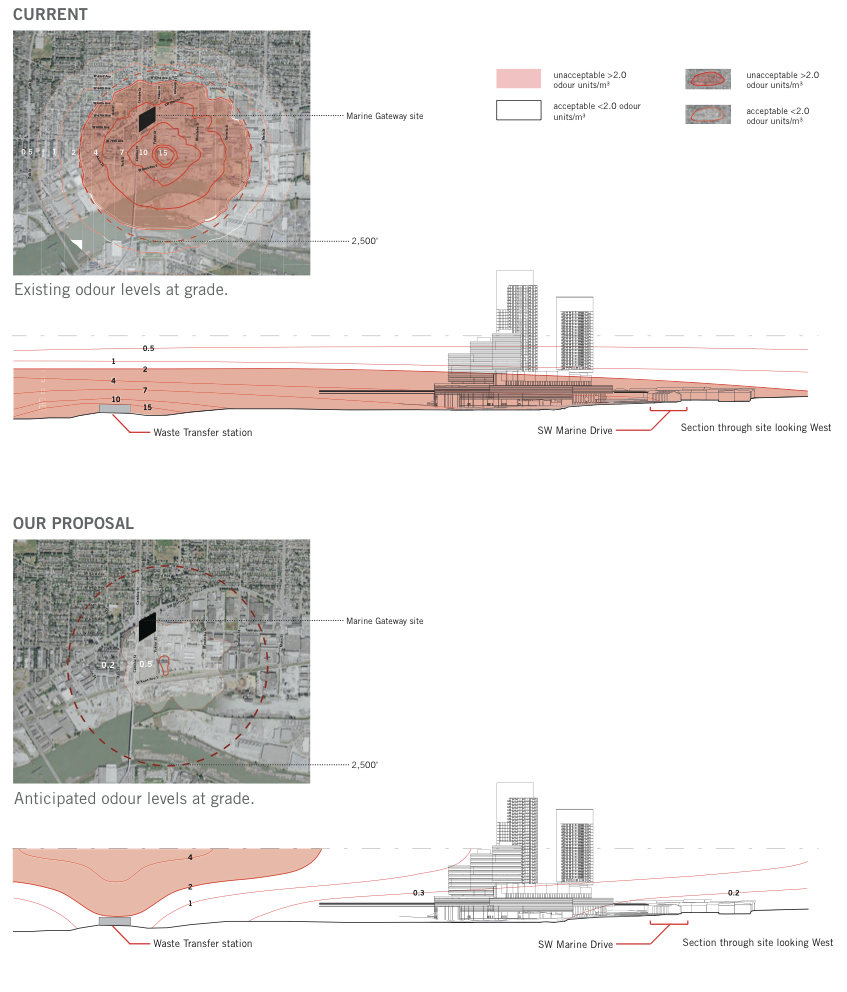
On the bracing subject of odours, the following links regarding air quality around a well known condo development (Marine Gateway) near the ‘Vancouver South Transfer Station’ (‘Dump’) forwarded to us by Aldus Huxtable:
1. ‘Addressing Waste Transfer Station Odour’, marinegateway.ca ,
2. ‘Dispersion Modelling of Vancouver South Transfer Station Odour Emissions’, RWDI, Dec 2009

Infographic: Vancouver Detached Home Price vs Government Intervention.

‘Infographic: Vancouver Detached Home Price vs Government Intervention’, care of Canadian Watchdog, 18 Aug 2012

“Young people are leaving B.C. for other provinces at the fastest rate in years, raising concerns about a sputtering economy and unaffordable housing.”

“BC stats from January to March show more than 2,500 have uprooted and left.
Both economists and folks who live here blame the economy, housing affordability, and the high cost of living in BC.
A woman we spoke with isn’t shocked by the mass exodus earlier this year. “No, it’s not surprising at all. I was actually thinking of doing that myself, especially towards the US; you get way bigger houses [in the States] for a small amount.”
One man tells us he’s done it before and could do it again.”
[Leave twice?! -ed.]
‘Thousands of people leaving BC for other provinces: Some Vancouverites not surprised, blaming jobs and expensive housing’, news1130.com, 16 Aug 2012 [hat-tip RESkeptic]

“Young people are leaving B.C. for other provinces at the fastest rate in years, raising concerns about a sputtering economy and unaffordable housing.
The latest numbers from B.C. Stats show that from January to March this year, 2,554 people left B.C. for other provinces. That’s an alarming jump that continues a negative trend started in 2011, when B.C. logged a net migration loss interprovincially of 1,920.
In an interview Wednesday Helmut Pastrick, chief economist for Central Credit Union 1, said B.C.’s negative migration “seems to be accelerating.”
Pastrick said those leaving B.C tend to be young people looking for better employment opportunities, but there also could be a “push and pull” factor of younger families seeking both better jobs and more affordable homes in other provinces. …
B.C. NDP leader Adrian Dix said interprovincial migration is “complicated” and B.C.’s negative trend covers a short period, so he doesn’t want to jump to conclusions.
But housing affordability and B.C.’s habit of exporting raw resources without developing manufacturing jobs are likely culprits, he said.
“If this trend continues in the coming quarters it is not good for the economy or the government’s record,” Dix said. “We have to focus on making things and manufacturing in a consistent way, and training our [workforce].”
B.C. Finance Minister Kevin Falcon was not available for an interview for this story.”

– from ‘Young people fleeing B.C. in big numbers: Are bad economy and pricey housing to blame?’, The Province, 16 Aug 2012

For dozens of other stories in this vein, see the ‘Avoiding Vancouver‘ sidebar category.
The bubble has been bad for our society.
– vreaa

Where Are We Now? – jesse’s Thoughts on the Vancouver Market

“Most years since 2005 have seen September inventory at least as high as Octobers but not by much. This year looks to be on balance a hybrid 2008-2010 scenario: inventory is off its highs but still elevated, sales are lackluster, and prices are starting to drop, but nothing as of yet that as yet looks as acute as 2008. So what can be expected for the rest of this year and next for sales and inventory?

We can first compare to 2008. 2008 saw Vancouver get hit by a freight train, most likely in part because lending was becoming difficult, with higher mortgage rates than today’s, but early 2009 saw such a dramatic decrease in price-payment ratios there was an immediate response to housing activity, in part buoyed by robust population growth. Both these shots in the arm are for the most part no longer present.

Nonetheless we are still in a mode where low interest rates are allowing some households to reduce their payments as their pre-2009 financing terms expire, and this tailwind will be mostly spent in a year or so (and as of now it’s mostly spent already). Rents are increasing and have been on the tight side in the past 2 years or so.

A slowdown in China’s investment spending has likely led to less capital flows being invested in Canadian real estate this year compared to 2009-2011. And this is not only because of so-called “HAM” but also indirectly through a recent boom in hard commodity prices that has subsided somewhat this year — look at how BC-headquartered resource company equities have been doing since 2009.

The Chinese central government has already approved a significant stimulus spend to come into place in Q4 of this year. That will lead to additional economic activity but this is unlikely to have the same impact as previous stimulus efforts as much of the spend will go into servicing existing outstanding nonperforming loans. I would expect some uptick in capital flows into Canada in 2013 but nothing like was seen in the past couple of years and will likely be short-lived.

Mortgage rate spreads have increased for a variety of reasons since 2011, which has partially offset falling interest rates seen earlier this year. Going forward we can expect further crimps on lending through increased spreads and increased loan rejections for Vancouver-area mortgages.

Population growth has continued to slow, in part due to unemployment still being elevated. This looks to be a cyclical trend that is highly dependent upon residential construction activity. It is the nature of BC’s economy that construction boom leads to population growth but as completions mount, population growth subsides, as it is doing now. This cycle looks to be on roughly a 10 year period and it looks 2012 and 2013 lie in a downdraft.

Units under construction are elevated relative to population growth and still appear to be increasing. As completions mount later on this year and into 2013 this will provide an additional headwind for the housing market.

Are there factors that could produce a renewed bout of strength? Well some navel gazing is in order — I for one did not anticipate the veracity of the stimulus from governments and how strongly they affected house prices. I am, now, trying to keep an open mind as to what could come to the rescue this time round, though any insight into what this might plausibly be would be greatly appreciated. A markedly improved US economy in 2013 would be a positive for Canada as a whole.

Aside any additional strength from factors not considered above, I see continued elevated inventory and lower sales continuing through the rest of 2012 and likely through 2013: we need only look at the early part of this century to see the effects of lower population growth. I think the months of inventory levels will be enough to put a downwards pressure on prices as measured on a year-over-year basis. This will not mean that prices are monotonically going to fall — seasonality sees prices buoyed in the spring for a variety of reasons — but any bouts of strength are likely to be muted before renewing their descent in the second half of the year. How much? I’ll say -5% by the end of 2012 and a further -10% by the end of 2013. And that is only a guess based on what I can see based on the factors above. If factors I considered above combine in some way to exacerbate effects, or if some real sh!t starts going down in, say, Asia, things could get worse.”

jesse (YVRHousingAnalyst) at VCI 17 Aug 2012

jesse’s price drop estimates are conservative but we reckon they’re sensible: they’re the high probability outcomes for the next two years.
We’d add that at any point buying could slow more rapidly, via the effect of sentiment change. If it suddenly becomes ‘common knowledge’ that prices are dropping (this is not yet the case), buyers would lose the desire to overstretch to buy, and the market could freeze up.
– vreaa

“A couple of weeks ago I hung out with a guy who doesn’t have a day job, he just renovates and flips. He was oblivious to the shift in the market, and quoted Global as saying prices were up.”

“A couple of weeks ago I hung out with a guy who doesn’t have a day job, he just renovates and flips. He was oblivious to the shift in the market, and quoted Global as saying prices were up (HPI). Another friend, who took out a home-equity loan to cover his daughters downpayment was even less aware (basically unaware that there is such as thing as a market that can change). When the truth gets out to the masses, we are going to see sales grind to a near dead stop.”
N at VCI 15 Aug 2012 6:18pm

When the “truth” of the falling market becomes obvious to the vast majority, all buying premised on rising prices will stop.
In Vancouver’s case, that describes the majority of the buying in recent years.
– vreaa